
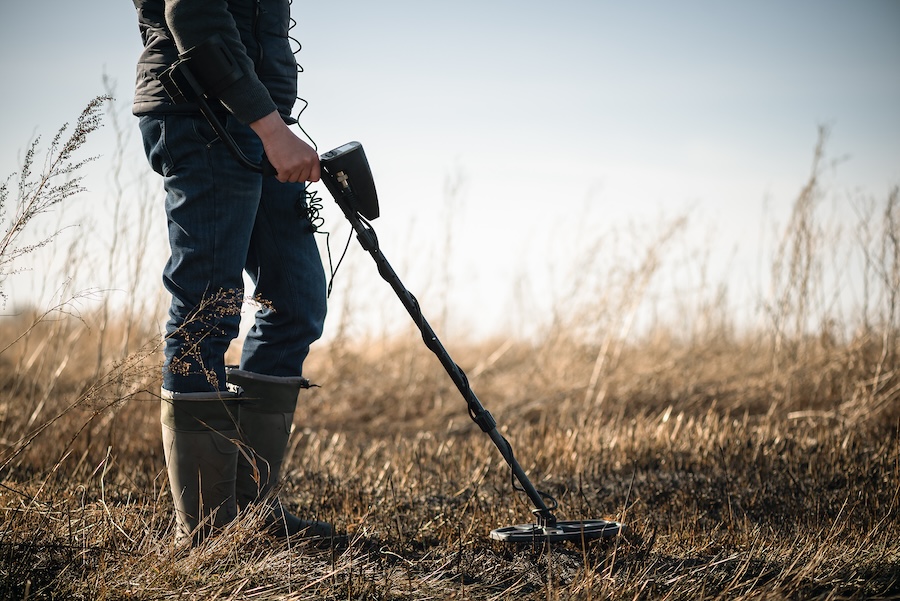
Yes, a metal detector can find meteorites. Most meteorites contain nickel-iron, a ferromagnetic material that registers on a detector’s coil, making this an accessible hobby for anyone willing to learn the basics. You don’t need expensive lab equipment or a geology degree. Even entry-level detectors from trusted brands like Garrett can produce real finds when used in the right location with the right settings.
The key is understanding what you’re looking for and how your detector responds to it. Iron and stony-iron meteorites are the most detectable types, and with proper preparation, a hobbyist can pull space rocks from the earth that have been sitting there for thousands of years.
Key Takeaways
- Most meteorites contain nickel-iron, making them detectable with a standard metal detector.
- Iron meteorites are the easiest to find, while stony meteorites require slow sweeping and high sensitivity settings.
- Arid desert regions like Arizona, New Mexico, and the Mojave are the best hunting grounds due to dry conditions that preserve specimens.
- Always combine your detector signal with a magnet test and visual inspection to confirm a genuine find.
- Laws vary by land type, so always research local regulations before hunting to ensure your finds are legally yours to keep.
- Garrett offers two strong detector options, the multi-frequency Vortex VX9 and the advanced pulse induction Axiom Lite, to suit hunters at any experience level.
The Three Types of Meteorites (and Which Ones a Detector Can Find)
Stony Meteorites
Stony meteorites make up more than 95% of all recovered meteorites. They have a rocky composition with only small amounts of metallic grains mixed in, which means they may not trigger a standard detector reliably. Some varieties called chondrites do contain enough nickel-iron to register, but the signal will be weak, slow sweeping and high sensitivity settings are essential.
Iron Meteorites
Iron meteorites are made almost entirely of dense nickel-iron, representing the cores of ancient asteroids. They are the easiest type to detect and produce strong, clear signals even beginner detectorists can recognize. They are also significantly heavier than Earth rocks of the same size, which is one of the first physical clues that something unusual may be in your hand.
Stony-Iron Meteorites
Stony-iron meteorites are the rarest type, accounting for less than 2% of all known discoveries. They are a mixture of rock and metal, the most famous variety, pallasite, contains olivine crystals inside a nickel-iron matrix. Because of their metallic content, they are still detectable with a properly calibrated detector, and their distinctive appearance makes field identification fairly straightforward.
Choosing the Right Metal Detector for Meteorite Hunting
Pulse Induction (PI) Detectors – The Preferred Choice
Pulse induction detectors are the top choice for serious meteorite hunters. They operate in All-Metal mode by default, meaning no discrimination circuit will accidentally filter out a meteorite signal.
They also handle highly mineralized desert soil far better than other detector types and can reach greater depth in strewn fields that have already been heavily searched. The Garrett Axiom Lite is a great pulse induction model for finding meteorites.
VLF (Very Low Frequency) Detectors
VLF detectors work in moderate soil conditions and are a reasonable entry point for beginners. High-frequency models designed for gold prospecting are more sensitive to small targets and can pick up tiny fragments a lower-frequency machine might miss.
One important caution: auto ground balance settings can treat small meteorites as background mineralization and cancel them out entirely. Always use manual ground balance when hunting meteorites. VLF detectors from Garrett with entry-level pricing and industry-leading technology include our Vortex VX9 model.
Coil Size and Settings
Choosing the right coil and dialing in your settings before you leave home will save a lot of frustration in the field. Here is what to know:
- Smaller coils (9–11 inch elliptical) are more sensitive to small near-surface fragments
- Larger coils (15 inches and up) provide greater depth and better coverage of wide open terrain
- Discrimination should be kept minimal or off – iron signals are exactly what you are hunting for
A mid-size coil is the most practical starting point for new hunters since most meteorites are not buried deeply. Once you have more experience reading signals in mineralized ground, you can adjust coil size to match the specific strewn field you are working.
Where to Hunt: Choosing the Right Location
Why Dry Climates Are Essential
In wet environments, iron meteorites oxidize, rust, and disintegrate over time. Arid regions preserve specimens for centuries or longer, which is why deserts produce the vast majority of finds worldwide. Dark, fusion-crusted meteorites also stand out visually against light-colored desert sand, giving hunters a secondary identification advantage beyond the detector signal alone.
Best Hunting Locations in the US
The United States has several well-documented regions that consistently produce meteorite finds:
- Arizona: Gold Basin and Franconia strewn fields are among the most productive in the country
- Texas and California: Both states have long recovery histories and continue to yield new specimens
- New Mexico BLM lands: Roosevelt County is a notable hotspot with multiple documented finds
- Mojave Desert dry lakebeds: Flat, open terrain that is ideal for systematic grid searching
Hunting a known strewn field dramatically increases your odds compared to searching random terrain. A strewn field is a zone where multiple meteorites from the same atmospheric fall have been recovered, often scattered across a miles-long elliptical area. Research strewn fields before your trip and focus your time on the most productive zones within them.
How to Identify a Meteorite in the Field
Physical Characteristics to Look For
Knowing what to look for before you dig separates productive hunters from those who spend all day chasing junk signals. The most reliable field indicators are:
- Magnetic response: Nearly all meteorites contain ferromagnetic nickel-iron and will attract a strong magnet
- Fusion crust: A dark, thin, glassy outer layer formed when the surface melted during atmospheric entry
- Unusual weight: Meteorites feel noticeably heavy for their size compared to surrounding rocks
- Regmaglypts: Shallow, thumbprint-like depressions pressed into the surface during the fall
- Out-of-place appearance: A black rock sitting among red desert stones immediately warrants a closer look
Field Tests and Signal Interpretation
After your detector signals, the next step is a magnet-on-a-stick test. A neodymium rare earth magnet mounted on a stick lets you confirm iron content without touching or contaminating the specimen. Magnet strength drops sharply with distance, so this works best on surface or near-surface targets and should be treated as a secondary check rather than a standalone test.
When reading your detector’s signal, approach the target from multiple directions. A genuine meteorite produces a consistent, stable response from every angle. Hot rocks and mineralized ground often shift signal character depending on orientation. A strong, repeatable signal is a positive sign, but always combine it with the magnet test and a visual inspection before digging.
Common “Meteor-Wrongs” to Avoid
Most signals in the field will not be meteorites, and false positives are part of the process. The most common offenders are hot rocks, which are naturally occurring magnetic minerals that produce strong detector responses and can even weakly attract a magnet.
Rusty iron debris and old slag are also frequent culprits. Never rely on a single test, signal behavior, magnetic response, and visual inspection together give you a confident identification.
Field Methodology: How to Search Systematically
Organized searching is what separates hunters who find meteorites from those who cover the same ground repeatedly without results. Use these practices on every outing:
- Walk grid patterns to ensure full, overlapping coverage of your search area
- Use GPS to log the exact location of every target you investigate, even junk
- Approach each signal from multiple angles before digging to confirm signal stability
- Bring water to rinse dust off rocks and reveal the true surface color and texture
Always pack for remote conditions since the most productive strewn fields are far from towns and reliable cell service. Keeping a log of recovered targets, including non-finds, helps you build a working map of the area that becomes more useful over return visits.
What to Do If You Find a Meteorite
Do not clean or scrub a suspected meteorite. The fusion crust is fragile and scientifically valuable, and removing it destroys features that researchers rely on for classification. Document the find location immediately with GPS coordinates and photograph the specimen before moving it.
Consider bringing it to a university geology department or natural history museum for professional classification. The Smithsonian’s National Museum of Natural History maintains one of the world’s largest collections and can direct you to the right resources. A classified meteorite carries significantly more scientific and collector value than an unclassified one.
Legal Considerations for Meteorite Hunters
Laws vary significantly depending on what type of land you are hunting. Many state courts hold that meteorites found on state-owned land belong to the state. Federal policy on public lands is unsettled, but the government has asserted ownership over large finds on federal property.
Private land is generally the clearest situation, with the landowner’s permission, finds typically belong to the hunter. Always research the regulations for your specific location before you go.
Best Metal Detectors for Meteorite Hunting: Garrett Recommendations
Choosing the right detector is one of the three keys to finding meteorites, and Garrett makes two models worth serious consideration depending on your experience level and budget. One is a capable multi-frequency machine for hunters with only little to modest experience , and the other is a pulse induction unit built for serious work in heavily mineralized desert soil.
Garrett Vortex VX9: VLF Detector, Entry Level Pricing
The Vortex VX9 is a strong starting point for new meteorite hunters who want reliable performance without a significant upfront investment. Its selectable multi-frequency technology lets you adapt to different soil conditions across the arid hunting grounds where meteorites are most commonly found.
- Weighs just 2.9 lbs and fully waterproof to 16 feet, making it easy to carry across long desert strewn fields
- Five selectable frequencies (5, 9, 13, 18, 25 kHz) plus two multi-frequency modes allow tuning for different soil mineralization levels
- High-resolution 175-point ground balance system helps reduce false signals from mineralized desert soil
- Zero discrimination mode across its seven search modes is essential for meteorite hunting where iron signals are the target
The VX9 won’t outperform a pulse induction machine in extreme ground conditions, but for hunters learning their first strewn field in moderate desert soil, it is a capable and well-priced entry point into meteorite detecting.
Garrett Axiom Lite: Pulse Induction, Advanced Detector
The Axiom Lite is built for exactly the kind of hunting environment where meteorites are most often found – heavily mineralized desert soil that overwhelms standard VLF detectors. If you are hunting known strewn fields in places like the Mojave, Gold Basin, or Roosevelt County, this is the machine to bring.
- Weighs just 4.2 lbs, making it the lightest detector in its pulse induction class and a practical choice for long days on remote terrain
- Terra-Scan dual-channel independent ground balance is engineered specifically for extreme mineralization, the exact condition found in productive desert strewn fields
- Sensitivity optimized for sub-gram targets means small meteorite fragments that other detectors miss will still register a clear signal
- A 16-hour built-in lithium-ion battery gives you a full day of hunting on a single charge in remote locations far from power sources
The Axiom Lite is the detector recommended for hunters who are serious about meteorite recovery – its pulse induction technology and extreme ground handling are exactly what the toughest strewn fields demand.
Recap: Can You Find a Meteorite With a Metal Detector?
Metal detectors are a proven tool for finding space rocks, and thousands of meteorites in museum and private collections were recovered by hobbyists using equipment available to anyone. The technology works because meteorites carry nickel-iron, and nickel-iron responds to a detector’s electromagnetic field in a way even basic machines can pick up.
The three keys to success are the right detector, the right location, and the skill to identify what you find. Start with a known strewn field in an arid region, dial in your preferred settings before heading out, and always combine your detector signal with a magnet test and visual inspection on every target. Success in meteorite hunting comes down to preparation, patience, and putting in time on productive ground.
Ready to find your first meteorite?Whether you start with the entry-level priced Garrett Vortex VX9 or go straight to the pulse induction Garrett Axiom Lite, the right detector makes all the difference. Contact our team to learn more.