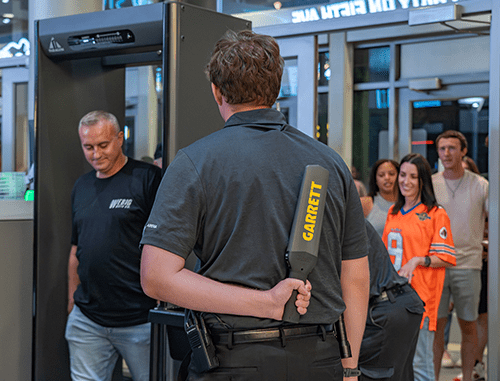
At Garrett, we know that even the smallest metal items, like safety pins, can create unnecessary slowdowns or confusion during security screening. Whether you’re a security professional managing foot traffic at a major venue or working as airport security, it’s important to understand how and why these common items can still set off metal detectors.
Most travelers don’t realize that safety pins, bobby pins, or even metal buttons might trigger alarms depending on the settings of the detector, leading to secondary screening or manual checks. That’s where we come in. In this guide, the Garrett team will walk you through how metal detectors detect safety pins, what screening teams should watch for, and how to help both staff and the public prepare for faster, smoother checkpoints without compromising safety.
Key Takeaways
- Even small safety pins can trigger metal detectors, especially in high-sensitivity environments like airports and courthouses.
- The magnetic field in a metal detector is easily disrupted by conductive metals like steel or nickel-plated safety pins.
- The number, placement, and packaging of pins (e.g., inside a money belt or carry-on) can all impact detection outcomes.
- Walk-through and handheld detectors vary in sensitivity, but both can identify small items like bobby pins and sharp metal objects.
- Security personnel should use handheld wands for secondary screening and follow TSA guidelines for screening sharp objects or metallic accessories.
- Garrett’s advanced metal detectors are engineered to detect even the smallest threats, helping streamline security without compromising accuracy.
Why Safety Pins Are a Concern in Security Screening
Safety pins might seem harmless and easy to overlook, but they’re made of metal, usually steel or nickel-plated alloys, which makes them conductive. Even small safety pins can be picked up by a sensitive walk-through metal detector because they disturb the magnetic field generated during scanning.
Just because something is small doesn’t mean it’s invisible to metal detectors. High-sensitivity systems like those manufactured by Garrett are designed to detect even small metal items like bobby pins, metal buttons, or the metal content in clothing or accessories.
Use Cases Where Safety Pins Matter
You’re more likely to run into issues with safety pins at places like airports, courthouses, government facilities, manufacturing facilities, or MRI pre-screening where strict security regulations are in place. These locations often enforce policies that require visitors to remove pins or pack pins in a clear plastic bag if they’re traveling with multiple pins or other sharp objects.
In high-security zones, security personnel are trained to inspect anything metallic. Even safety pins in a carry-on bag could prompt additional screening. The goal is to avoid delays and eliminate any potential security threat, even from everyday items.
How Metal Detectors Work: A Quick Breakdown
Magnetic Field and Object Detection
At the core of every detector is a transmitter coil that emits a magnetic field and a receiver coil that reads feedback. When a metallic object, like a safety pin, bobby pin, or even a small coin, enters that field, it disrupts the signal.
Metal detectors detect these changes and flag the item for review. Because safety pins are conductive, they almost always register, especially when bundled together or attached near other items in a carry-on or jacket pocket.
Sensitivity Settings and Detection Thresholds
Not all detectors operate the same way. Some devices are built to find larger items, while others can detect small metal items like safety pins or belt buckles.
Security officers can adjust sensitivity settings depending on the screening environment. Many airports use custom settings to find small metallic objects, or hidden tools, ensuring even a single pin tucked into the inside seam of clothing doesn’t go unnoticed.
What Happens If You’re Wearing Safety Pins Through Security?
Primary Screening and Alarms
When safety pins set off metal detectors during the first scan, security officers may stop you for further inspection. Even if safety pins are generally allowed, the final say always belongs to the security officer. If there’s any doubt, you might be asked to remove pins or explain why you’re wearing them. To avoid delays, fewer items and a little preparation can make a big difference.
Wanding and Manual Inspection
In a separate screening or private area, handheld wands are used to pinpoint the source of the alert. These tools are sensitive enough to detect the metal content of a safety pin, even when it’s hidden beneath clothing.
Once identified, security personnel may ask to inspect the object manually. If it’s a safety pin or part of a pins set and it poses no risk, they’ll usually allow you to continue. But depending on the situation, you might be asked to secure the item in checked luggage or a carry-on that goes through additional screening.
Security Recommendations: Best Practices for Staff and Visitors
For Visitors and Attendees
If you’re heading to a location with metal detectors, especially for airport security, it’s smart to remove safety pins before entering the screening zone. While most travelers don’t think twice about small metal items, even a few pins or bobby pins can set off metal detectors, triggering unnecessary secondary screening.
To avoid delays, place sharp objects like metal buttons and safety pins in a clear plastic bag and drop it in the screening bin. Security officers may ask about items, especially if they’re in your carry on bag, so this little preparation can make a big difference.
For Security Personnel
Security personnel should understand how small metal items like pins and metal content in belts can trigger a metal detector. These items interact with the magnetic field, often mimicking the signal of a more serious security threat.
Using handheld wands after a triggered alarm is helpful, especially if you’re dealing with metal implants, a knee replacement, or even a money pouch hidden under clothing. The key is to apply security guidelines consistently and recognize the signature of low-risk metal objects.
The Role of Advanced Detectors in Identifying Small Threats
Technology Behind High-Precision Detection
Garrett metal detectors are more advanced than ever. With multi-zone and pinpoint detection, a walk-through metal detector can spot a safety pin hiding in a jacket, or a money belt lined with coins.
With the right discrimination settings, these detectors can ignore harmless metal items – like implants, small pins, or everyday objects – so they don’t trigger unnecessary alarms. This helps security officers focus on real threats.
How Our Detectors Are Calibrated for Accuracy
Our detector systems use customizable sensitivity levels, allowing fine-tuned settings that minimize false alarms while still catching potential threats like sharp objects or metal content hidden on the body.
We’ve field-tested these detectors in major airports, schools, courthouses, and more. Whether it’s a checked bag full of gadgets or someone wearing a jacket full of safety pins, our systems are trained to identify risk without overreacting to common metals.
Why Our Metal Detectors Are Built for Modern Security Needs
From Safety Pins to Serious Threats
A single safety pin may seem harmless, but many travelers carry multiple pins, sometimes unknowingly. Our detectors understand that small doesn’t mean insignificant when it comes to public security.
From sharp ends hidden in clothing to metal hardware in bags, our machines detect it all, so you don’t have to wonder how many pins are too many. Whether you’re a venue operator or part of airport security, we help you manage both minor alerts and major concerns.
Trusted by security personnel worldwide, our detectors are the silent backbone of thousands of secure spaces. Whether you’re screening a stadium crowd or guarding a courthouse, we help you protect what matters, without worrying about safety pins or other small metal items.
Garrett Metal Detectors for Security Screening
In today’s high-security environments, airports, schools, courthouses, and event venues, metal detectors play a critical role in detecting small threats before they escalate. Safety pins, bobby pins, and other seemingly harmless objects can still raise red flags, especially when worn in clusters. That’s why Garrett’s security-focused metal detectors are engineered to detect even the smallest metal items without slowing down checkpoint efficiency.
Garrett Paragon: Advanced Walk-Through Metal Detection
The Garrett Paragon is a best-in-class walkthrough metal detector designed for pinpoint accuracy across 66 independent zones. Ideal for major airports and government facilities, the Paragon excels at identifying small metallic objects like safety pins without triggering false positives from everyday items like phones.
- Detection Zones: 66-zone system with 22 adjustable horizontal bands
- Sensitivity Levels: 200 fine-tunable levels for custom screening
- Dimensions: 30″ or 32.5″ width, 81.5″ height, 23″ depth
- Environmental Rating: IP65 water and dust resistance for indoor/outdoor use
- Power & Backup: Standard 1.5 Ah emergency battery (1 hour); optional 14 Ah battery (10 hours)
Whether you’re screening for hidden sharp objects or clusters of safety pins, the Paragon’s Ambiscan technology and Quick-Q setup make it easy to differentiate benign items from genuine threats. It meets TSA and global airport standards, making it a trusted solution for efficient, reliable security screening.
Garrett Guide: Rugged Handheld Precision
The Garrett Guide is a handheld metal detector built for frontline personnel who need speed, precision, and portability. From secondary screening of safety pins and bobby pins to scanning in tight spaces or crowded areas, this compact device delivers professional-grade performance.
- Dimensions: 16″ long, 3.375″ wide, only 1.125″ thick
- Weight: Just 1 lb for easy all-day use
- Battery Life: Up to 125 hours on a rechargeable 3.8V lithium-ion battery
- Sensitivity: 7 selectable levels with automatic tuning
- Alerts: Audible and vibration options with LED indicators
Whether used at security checkpoints or in private screenings for sharp objects like safety pins, the Guide offers consistent detection of small ferrous and non-ferrous metals. It’s IP65-rated, drop-tested to military standards, and easy to charge via USB-C, making it an indispensable part of any professional security toolkit.
Recap: Can Metal Detectors Detect Safety Pins?
Safety pins may be small, but in a modern security environment, every metal item matters. Understanding how these everyday objects interact with metal detectors helps reduce false alarms, speed up screening, and improve the overall experience for both staff and visitors.
With the right preparation from travelers and the right equipment and training for security teams, checkpoints can stay efficient without sacrificing safety. Advanced systems designed for precise detection allow personnel to quickly identify harmless items while staying focused on real threats.At Garrett, we design our detectors to deliver reliable performance in high-traffic, real-world conditions where accuracy and speed are critical. From small metal items to serious risks, the goal is always consistent, dependable screening. If you’re planning a new security program or upgrading an existing one, contact our team at Garrett to help select the right metal detector setup for your application.