
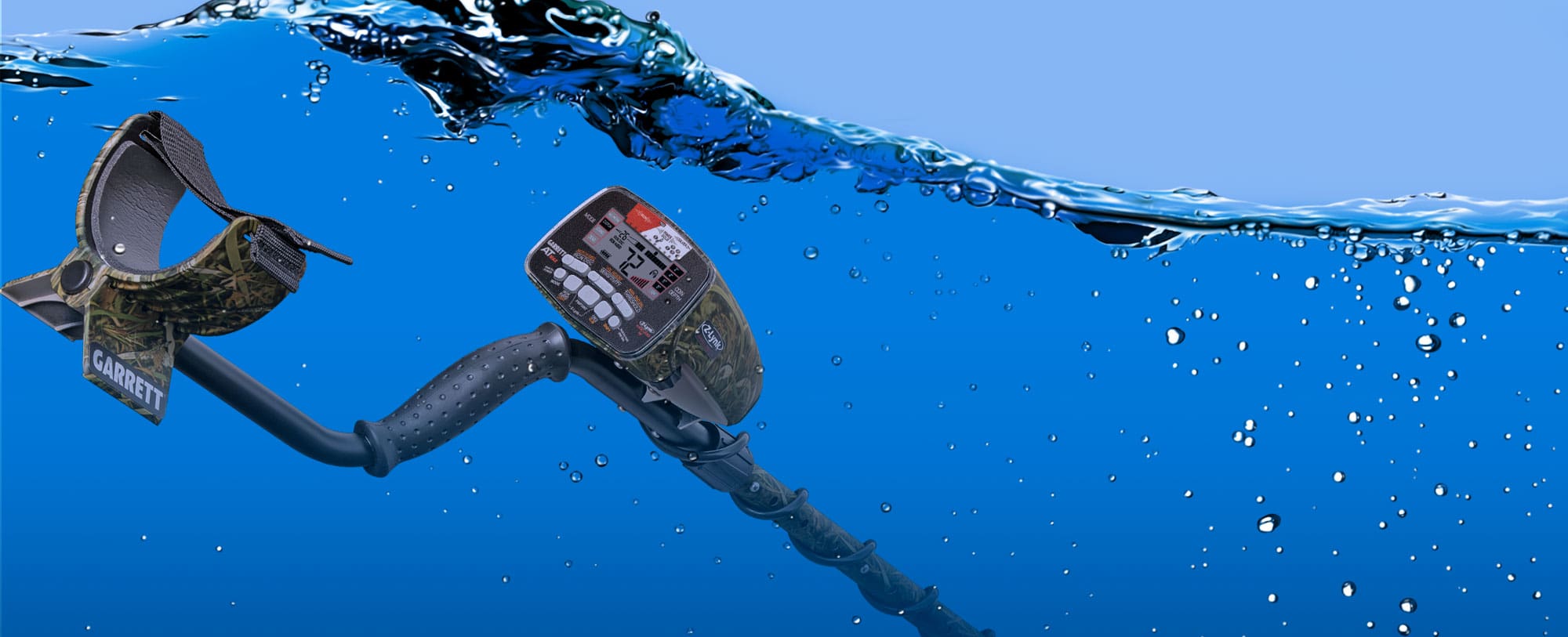
Somewhere beneath the surface of every beach, river, and lake lies a history of lost things, hidden treasures waiting to be claimed. Coins dropped by swimmers, rings slipped from wet fingers, relics resting in riverbeds, gold and silver jewelry carried into the surf and never recovered. The good news is that yes, metal detectors absolutely can work underwater if you are using the right model.
The right equipment makes it possible to search lakes, rivers, ocean floors, and surf zones with confidence. Our team at Garrett will cover how underwater metal detectors work, what features matter most, how deep they can detect, and how to choose the right detector for your environment.
Key Takeaways
- Metal detectors can work underwater, but only if the detector is built for full submersion.
- Waterproof coils are not the same as fully submersible detectors, so checking the full unit rating matters.
- Saltwater is more challenging than freshwater and often requires different detector technology for stable performance.
- PI detectors perform best in saltwater, while VLF detectors are often better for freshwater target discrimination. Simultaneous multi-frequency detectors are also an excellent performer in saltwater.
- Search depth depends on target size, sediment conditions, mineralization, and the detector’s overall design.
- The Garrett Vortex series gives underwater hunters submersible options built for beaches, surf, and shallow diving.
How Underwater Metal Detectors Work
Metal detectors work by sending a magnetic field into the ground, or water, and picking up the signal that bounces back when that field hits a metal object. The search coil generates the field, and when a coin, ring, or piece of metal disrupts it, the machine alerts the user with a tone or vibration. The basic science works the same underwater as it does on land, and most metal detectors are built around this same core principle regardless of where they are used.
Water itself does not block magnetic signals, but it does change how they travel. Saltwater is especially challenging because dissolved minerals increase electrical conductivity, which can cause false signals constantly on a standard unit. Fresh water is far less conductive and causes fewer problems when detecting. That said, most models not designed for submersion will fail underwater, not because of the signal, but because water will destroy the electronics inside the control box.
Waterproof vs. Fully Submersible: What’s the Difference?
A waterproof metal detector and a fully submersible metal detector are not the same thing, and mixing them up can cost you a ruined machine. Waterproof coils are designed to handle wading, splashing, and shallow water, typically just the search coil is sealed, while the control box must stay dry. These are suitable for hunting in ankle-deep surf or along the shoreline, but they are not built to go fully underwater.
Fully submersible detectors are built so that every component, the control box, the coil, and the headphones, can go completely underwater. These are the detectors used by divers and swimmers searching deeper zones for lost treasure.
The IP68 rating is the standard to look for. It means the unit has been tested and certified to withstand continuous submersion beyond one meter. Before taking any detector into the water, check the IP rating on the control box, submersion depth rating, and headphone compatibility.
Types of Metal Detectors That Work Underwater
Pulse Induction (PI) Detectors
Pulse induction detectors work by sending short, powerful bursts of current through the search coil, then measuring how long it takes for the resulting magnetic field to collapse. Any metal object in range slows that collapse slightly, and the detector picks up that delay as a signal. It is a straightforward but highly effective method of detecting metal objects at depth.
PI detectors handle salt water far better than most single frequency detectors.. Because they operate on a different frequency principle than VLF detectors, they are not fooled by the high conductivity of saltwater and dissolved minerals that cause false signals in other detectors.
Very Low Frequency (VLF) Detectors
Very low frequency detectors work by transmitting a continuous electromagnetic field at a specific low frequency and analyzing how that field is disrupted by targets. They are the most common type of detector on the market and are available at a wide range of price points, including entry level models suitable for beginners. In calm, freshwater environments they perform excellently.
How Deep Can Underwater Metal Detectors Detect?
Metal detectors specifically built for underwater use, like our Vortex series at Garrett, are built to be submerged at depths of up to 16 feet. It’s worth clarifying, though, that submersion depth and detection depth are two very different things.
A typical 12-inch searchcoil can detect a coin-sized object roughly 12 inches into the sand or sediment. When planning a dive, both how deep you can take the detector and how deep it can sense into the bottom are worth considering – just don’t confuse the two.
Several things influence how deep a submersible metal detector can sense a target below the surface. Dense, packed sediment on the ground reduces signal penetration compared to soft sand, and murky water with high mineral content can interfere with even the best detectors.
What Can You Find with an Underwater Metal Detector?
The variety of targets available to underwater metal detecting enthusiasts is one of the things that makes the hobby so compelling. Coins are among the most common finds at beaches, river crossings, and historic swimming holes that have seen centuries of dropped change accumulate on their floors. Gold and silver coins from wading areas near historic ferry crossings can be especially valuable metals worth recovering.
Jewelry is another top target, particularly in surf zones where rings and necklaces slide off wet hands and necks constantly. Relics and artifacts turn up at submerged historical sites and along riverbeds that have changed course over time.
Shipwreck sites can hold hidden treasures ranging from ship fittings to personal belongings. Everyday lost valuables round out the list for treasure hunters working popular recreational water areas.
Where Underwater Hunters Search
The best hunting locations are places where people have gathered around water for a long time. Surf zones and tidal areas near popular beaches see constant jewelry and coin loss, and tidal action keeps turning over the sand. Rivers and creek beds near old crossings or historic towns can hold relics going back hundreds of years, making them excellent choice locations for detecting.
Lakes and reservoirs, especially those near campgrounds and swimming areas, collect decades of dropped metals in shallow water zones. Scuba diving locations give access to deeper targets that wade hunters simply cannot reach, and those spots often go completely untouched because most metal detectors used by casual hobbyists never go that deep.
Tips for Getting Started with Underwater Metal Detecting
Starting out in calm, shallow water is the smartest move for anyone new to underwater detecting. Shallow water lets you hear and feel how your detector responds to different targets without the added challenge of full submersion. Spend time learning what coins sound like versus iron before moving to deeper or more complex submerged sites, this is where most metal detecting skill is built.
A few other habits will serve you well from the start. Research local regulations before you hunt anywhere, many beaches, rivers, and lakes require permits or prohibit detecting entirely. Use a mesh pouch that drains quickly and holds up underwater. Hunt during or after low tide when surf zones are most accessible.
Log your finds and note productive locations for return trips, and if your unit includes GPS mapping, use it, tracking where you have already searched saves time and improves results over multiple sessions.
Industry Leading Underwater Metal Detectors From Garrett
If you are ready to take your metal detecting underwater, having the right machine makes all the difference. Garrett is one of the most trusted names in the hobby, and our Vortex series was built specifically with submersible performance in mind. Here is a closer look at three models worth considering.
Garrett Vortex VX5
The Vortex VX5 is our entry point into fully submersible multi-frequency detecting, offering serious underwater capability in a lightweight, upgradeable package that punches well above its price.
- Fully submersible up to 16 feet (5 meters), making it a capable underwater metal detector for surf hunting, wading, and shallow diving
- MD-MF Multi-Frequency Multi-Dimensional technology delivers exceptional performance in freshwater environments, virtually eliminating false signals – and holds its own in saltwater too.
- Weighs just 3 lbs with the coil cover, reducing fatigue during long beach or underwater sessions
- Built-in rechargeable lithium-ion battery delivers approximately 15 hours of use on a single charge
- Four search modes (Zero, Standard, US Coins, and Custom) cover most detecting scenarios from dry sand to submerged ground
- Software-upgradeable to the VX7 or VX9, meaning you are not locked into entry level performance as your skills grow
For detectorists who want a fully submersible metal detector that can grow with them without buying a new machine, the Vortex VX5 is a smart starting point.
Garrett Vortex VX7
The Vortex VX7 steps up the capability of the series with dedicated saltwater modes and more refined target identification, making it a stronger tool for treasure hunters working ocean and surf environments.
- Fully submersible up to 16 feet (5 meters) with the same waterproof construction trusted across the Vortex line
- Offers two single frequencies (5 kHz and 13 kHz) plus simultaneous Multi and Multi-Salt modes, giving you the right frequency for both fresh water and salt water conditions
- Five search modes including a dedicated Beach mode make this one of the more versatile detectors on the market for coastal and underwater use
- 2-tier Target ID system and 5-tone audio help distinguish valuable metals like gold and silver from iron and other junk targets
- Iron Audio feature lets you hear iron targets rather than ignoring them entirely, giving you more control over what you dig
- Built-in Z-Lynk wireless and a backlit LCD display round out a feature set that rivals detectors at significantly higher price points
The Vortex VX7 is an excellent choice for treasure hunters who regularly move between freshwater and saltwater environments and need a single submersible metal detector that handles both with confidence.
Garrett Vortex VX9
The Vortex VX9 is the flagship of the our Vortex series, built for detectorists who want maximum frequency control, faster target separation, and advanced tools for finding treasure in the most demanding underwater conditions.
- Fully submersible up to 16 feet (5 meters) with seven frequency options — 5 kHz, 9 kHz, 13 kHz, 18 kHz, 25 kHz, Multi, and Multi-Salt — covering virtually every detecting environment imaginable
- Seven search modes including Thin Coins, Fast, and a dedicated Beach mode make this one of the most adaptable underwater metal detectors available
- 3-level variable recovery speed lets you fine-tune how quickly the search coil resets between targets, which is critical in high-trash zones and dense underwater debris fields
- 3-tier Target ID combined with 5-tone audio gives experienced detectorists a detailed picture of what is in the ground before they ever start digging
- 8 levels of adjustable Iron Volume and 175-point High-Resolution Ground Balance provide precise control over how the machine handles mineralized soil and saltwater interference
- Built-in rechargeable lithium-ion battery offers approximately 15 hours of run time, and integrated Z-Lynk wireless keeps audio output reliable whether you are on the surface or submerged
Whether you are a new diver learning to read underwater signals or an experienced detectorist hunting deep surf zones and submerged sites, the Vortex VX9 delivers the advanced technology and depth of control to match your ambition.
Understanding If Metal Detectors Work Underwater
Metal detectors absolutely work underwater, as long as you use the right equipment. A waterproof coil on a standard detector is not enough for real underwater work. You need a fully submersible machine with an IP68 rating on every component, including the headphones. That single detail separates a detector that survives the water from one that gets destroyed by it, and it is the first thing any serious treasure hunter should verify before buying.
The technology choice is just as important as the waterproofing. PI detectors work well in saltwater and ocean environments where conductivity can challenge other technologies. VLF detectors are an excellent choice in freshwater, where their ability to discriminate between valuable metals and junk helps you spend more time on real targets.
For saltwater beaches and surf, the Vortex’s special Multi-Salt multi-frequency mode is purpose-built to handle the conductivity challenges of those environments, giving you the best of both worlds without switching machines.Match the right metal detector to your environment, check every rating before you submerge it, and you will have a tool that earns its place on every trip to the water. And if you need help choosing the right underwater detector – reach out to our team at Garrett.