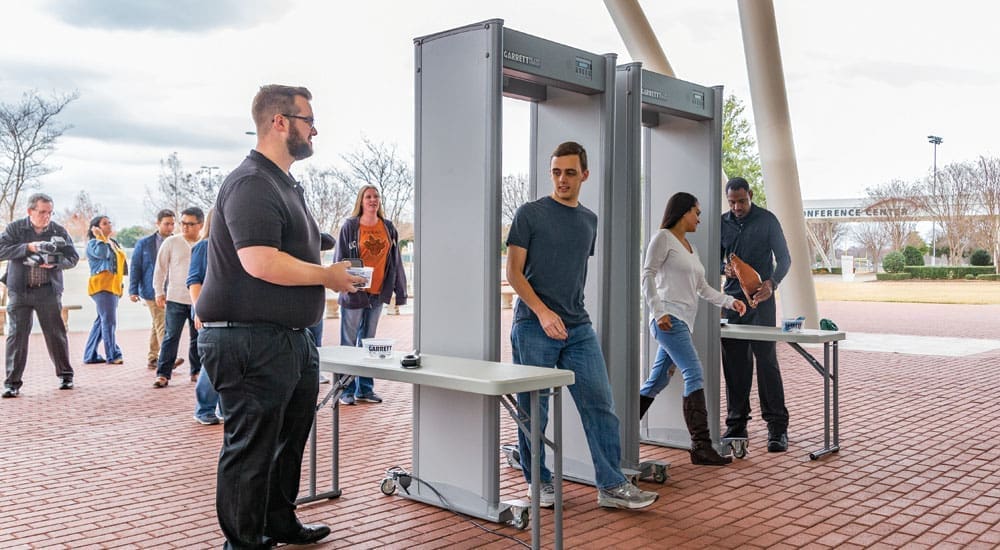
There’s a common misconception that all metals automatically trigger metal detectors. But the truth is, stainless steel doesn’t always play by the rules. While standard metal detectors easily catch conductive metals like copper, iron, or aluminum, stainless steel is harder to detect due to its magnetic properties and electrical conductivity.
So who should care? Travelers with stainless steel jewelry or medical implants like a joint replacement, security personnel scanning for hidden tools, and manufacturers trying to avoid metal contamination all need to understand how stainless steel interacts with metal detectors and other screening devices.
Knowing how these detectors work can save time at security checkpoints and prevent false signals or missed detection. At Garrett, our team has developed a range of industry-leading metal detectors capable of picking up stainless steel. We’ll walk you through the challenges and also the solutions to detecting stainless steel in different environments.
Key Takeaways
- Stainless steel is harder to detect because of its low magnetic permeability and poor electrical conductivity.
- Less sophisticated metal detectors may miss small stainless steel items unless they are highly sensitive or properly calibrated.
- The size, shape, and orientation of stainless steel objects play a major role in whether they trigger detection.
- Common stainless grades like 302, 304, and 316 are especially difficult to detect due to their non-magnetic nature.
- Detection success improves with high-frequency or pulse induction detectors and proper scanning techniques.
- Garrett metal detectors, including the Paragon, PD 6500i, Guide, and SuperScanner V, are built to reliably detect stainless steel in both security and industrial settings.
Understanding Metal Detector Technology
Basic Detection Principles
Most metal detectors detect metals by generating magnetic fields from a transmitter coil. When a metallic object enters that field, it disrupts the signal, which is picked up by the receiver coil and interpreted by the detector. This principle applies whether it’s detecting iron, aluminum, or other metals.
The strength of that signal depends on a few things: the metal’s conductivity, magnetic properties, and how it interacts with the field. Stainless steel, due to its low magnetic permeability and relatively poor electrical conductivity, produces a weaker signal than ferrous metals or highly conductive materials like copper or silver.
Types of Metal Detectors
Walk-through metal detectors, handheld wands, and industrial-grade detectors all operate on similar electromagnetic principles, but their effectiveness depends heavily on the equipment itself.
While many standard detectors used in airport security screening are tuned to detect weapons and larger threats, sometimes missing smaller stainless steel items, Garrett walk-through metal detectors like the Paragon and PD6500i are built to handle more demanding scenarios.
Garrett handheld detectors like the Guide and SuperScanner V are engineered for high sensitivity and reliable metal detection. These devices can pick up stainless steel items, even smaller or low-conductivity pieces, making them ideal for security screening, loss prevention, and detailed secondary inspections where accuracy and consistent performance matter most.
These advanced units offer higher sensitivity and precise signal processing, making them highly capable of detecting stainless steel, even when it’s small or low in conductivity.
Why Stainless Steel Often Evades Detection
Low Magnetic Permeability
Magnetic permeability affects how well a material responds to magnetic fields, which is a crucial role in detection. Stainless steel has low magnetic permeability, especially austenitic stainless steel like grades 302, 304, and 316. That makes it harder for most metal detectors to identify its presence.
Unlike carbon steel or iron, which produce strong magnetic responses, stainless steel falls into a gray area. It’s technically a ferrous metal, but not one that always behaves like it in electromagnetic fields. That means your run of the mill detectors may miss it unless it’s large, dense, or close to the coil.
Poor Electrical Conductivity
Electrical conductivity is another key factor in metal detection. Conductive metals like copper, aluminum, and silver create stronger eddy currents, which in turn generate a more noticeable signal. Stainless steel has much lower conductivity compared to these metals.
As a result, the response from a stainless steel object is weaker and may not trip the alarm for some detectors unless they have been calibrated for higher sensitivity. That’s why standard metal detectors might not catch smaller items like stainless screws or certain types of jewelry, while more sensitive devices can.
Size, Shape, and Orientation Matter
Object Size
Size matters when it comes to detection. A small metallic object made from stainless steel often won’t be noticed by standard detectors. To produce a detectable signal, stainless steel typically needs to be about 1.5 times larger than a similar item made of iron or carbon steel.
Real-world examples include metal hardware like screws, knives, or even orthopedic implants. A small stainless screw may not trigger some metal detectors, but a large stainless tool or implant might, especially in international airports with higher screening standards.
Equipment Settings
The settings on metal detectors also matter. Low frequency settings are better for large, deep items, while higher frequencies are more sensitive to small, conductive materials like stainless steel.
Adjusting the detector’s threshold can reduce false signals while still picking up non-ferrous or low-conductive metals. For environments like public safety or security checkpoints, finding the right balance is essential for both safety and efficiency.
Security Screening Detectors
Walk-Through Metal Detectors
Walk-through metal detectors are widely used at airports, schools, stadiums, and public venues to screen large numbers of people quickly and safely. While some standard systems are primarily tuned for common metals and larger threats, Garrett walk-through detectors are industry-leading and engineered with advanced sensitivity to detect a wide range of materials, including stainless steel.
Because stainless steel has low magnetic permeability and lower electrical conductivity, small or thin items can be difficult for basic systems to detect. However, Garrett systems use enhanced magnetic field control, multi-zone detection, and precise signal processing to identify stainless steel weapons, tools, and other potential threats that less advanced detectors might miss.
Handheld Metal Detectors
Handheld wands provide a more detailed search. Tools like the Garrett Super Scanner V are popular because they allow security personnel to sweep close to the body or inside bags. These detectors are more likely to pick up smaller stainless steel objects due to their proximity and targeted use.
At airport security or during public safety checks, handheld detectors serve as a backup for finding items missed by walk-through scanners. They are useful for locating medical implants, jewelry, or hidden tools that require a more precise scan.
Common Stainless Grades and Their Detection Challenges
Grade 302
Grade 302 stainless steel is often used in metal hardware like fasteners, screws, and springs. It’s one of several non ferrous metals with low magnetic permeability and poor electrical conductivity, making it harder for standard metal detectors to identify. Even though it contains iron, its structure reduces its magnetic properties significantly.
Because of that, many metal detectors detect 302 stainless only when it’s present in larger pieces or in close proximity to the transmitter coil and receiver coil. Small items may not trigger the signal strong enough to cause an alarm, especially in low frequency detectors used in public safety or basic security checkpoints.
Grade 304
Grade 304 stainless steel is found in everyday items like cutlery, kitchen sinks, and piping. It’s one of the most common metals used around the world, yet it’s also one of the most difficult for standard detectors to pick up due to its low electrical conductivity and non-magnetic nature.
This creates a common misconception: because it’s so widely used, people assume it always triggers detection. In reality, less advanced metal detectors struggle to detect 304 unless it’s large or combined with other metals that have higher conductivity.
Grade 316
Grade 316 stainless steel is valued for its corrosion resistance and is used in marine gear, medical implants, and surgical tools. It includes added elements like molybdenum and nickel, and can become slightly magnetic when cold-worked, but its magnetic permeability remains low overall.
Even though it plays a crucial role in high-moisture environments and is commonly found in orthopedic implants and joint replacement components, many metal detectors, particularly those not rated for high sensitivity, won’t detect it easily.
Certain types of detection equipment used in international airports or medical facilities, like Garrett detectors, have better success due to enhanced sensitivity and calibration for medical-grade metals.
How to Increase Detection Success
Use the Right Equipment
Most standard metal detectors aren’t designed to detect stainless steel well because it doesn’t conduct electricity effectively and lacks strong magnetic fields. That’s why it’s important to use certain metal detectors specifically rated for low-conductivity or non ferrous metals.
For better results, choose high-frequency or pulse induction detectors. These devices generate stronger electromagnetic fields and can identify subtle eddy currents in conductive metals like stainless steel, aluminum, copper, brass, and even precious metals like gold and silver.
Adjust Detector Settings
Many detectors have customizable settings that let you fine-tune their ability to identify difficult materials. Increasing the sensitivity threshold helps detect stainless steel and other materials that may otherwise be overlooked.
Switching to specialty modes, such as high-frequency operation, also improves performance. This is particularly helpful for detecting metallic objects in environments where false signals from common metals or certain metals with similar properties might otherwise cause issues.
Perform Proper Object Placement
Detection technique matters most when using handheld metal detectors. Slow, close scanning and changing sweep angles allow the magnetic field to better interact with the target, improving detection of small or low-profile stainless steel items.
Walk-through detectors work differently. Systems like the Garrett Paragon and PD 6500i use bilateral detection and multi-zone analysis to automatically compare left and right signals, providing superior object characterization without relying on operator technique.
Easily Detect Stainless Steel With Garrett Metal Detectors
When you’re screening for stainless steel weapons at security checkpoints, Garrett’s line of walk-through and hand-held detectors offer unmatched performance. Here’s a breakdown of four standout models that excel at detecting stainless steel in both security and personal-use scenarios.
Garrett Paragon
The Garrett Paragon is a cutting-edge, IP65-rated walk-through metal detector built to handle stainless steel detection in high-security and outdoor environments. With 66 zones and robust customization features, it’s ideal for airports, stadiums, and venues needing precise threat identification.
- 66 Detection Zones: Pinpoint left/center/right placements across 22 horizontal bands.
- Ambiscan & Quick-Q: Customize directional programming and sensitivity and filter out non-threat items like phones.
- Environmental Resistance: IP65-rated for full weatherproof deployment indoors or out.
- ECAC 2.1 with SMD Compliance: The Paragon meets ECAC 2.1 standards with Security Metal Detection, ensuring advanced threat detection for high-security environments.
The Paragon excels in identifying stainless steel threats without compromising throughput. For any operation needing elite performance in metal detection, it’s a top-tier option.
Garrett PD 6500i
The Garrett PD 6500i balances reliability and high-end pinpointing with 33 detection zones and multi-environment capability. Whether installed at a courthouse or a concert venue, it accurately identifies concealed stainless steel objects while maintaining crowd flow.
- 33 Detection Zones: Complete body scan coverage from head to toe.
- Dual-Side Scanning: Transmitters/receivers in both panels for even detection.
- Interference Suppression: Maintains accuracy near other electronics.
- Homeland Security Approved: Meets TSA, ECAC, and SAFETY Act certifications.
With network capability and easy upgrades, the PD 6500i remains a trusted favorite for professional stainless steel detection in secure locations.
Garrett Guide
The Garrett Guide is a rugged, IP65-rated handheld scanner engineered for extended runtime and high sensitivity, making it perfect for frontline personnel or hobbyists focused on stainless steel detection. Despite its lightweight design, it delivers professional-grade performance.
- 7 Sensitivity Levels: High-sensitivity mode can detect even needles.
- Long Runtime: 125+ hours on a single USB-C charge.
- IP65 Protection: Resistant to dust, water, and outdoor use.
- Offset Interference Control: The Guide features an offset button that helps eliminate interference from nearby handheld metal detectors or electronic devices.
From event staff to security guards inspecting bags or bodies, the Guide gives stainless steel seekers a dependable, all-day tool in hand.
Garrett SuperScanner V
The Garrett SuperScanner V is the classic handheld metal detector trusted globally, optimized for simplicity and reliable stainless steel detection. Its durable design and automatic tuning make it a go-to for security guards, police officers, and event staff.
- Automatic Tuning: No manual adjustments needed.
- Battery Life: 100+ hours on one 9V battery.
- Sensitivity Override: Eliminate interference near rebar or metal doors.
- Proven Detection Range: Up to 9″ for pistols and 3″ for razor blades.
Efficient, durable, and field-proven, the SuperScanner V remains a gold standard in quick-response metal detection, especially when identifying stainless steel threats fast.
Recap: Does Stainless Steel Set Off Metal Detectors?
So, does stainless steel set off metal detectors? The answer is: sometimes. It depends on the grade of stainless steel, the size and shape of the item, and, most importantly, the quality of the detector being used. Many standard detectors struggle due to stainless steel’s low electrical conductivity and weak magnetic response.
That’s why customers around the world depend on Garrett, an industry leader in metal detection. Our full range of Garrett walk-through and hand-held detectors, including the Paragon, PD6500i, Guide, and SuperScanner V, are built to detect stainless steel items effectively.When you’re identifying threats at a checkpoint, we’ve got the tools to help. Need help choosing the right detector for your application? Contact us, we’re here to walk you through it.