
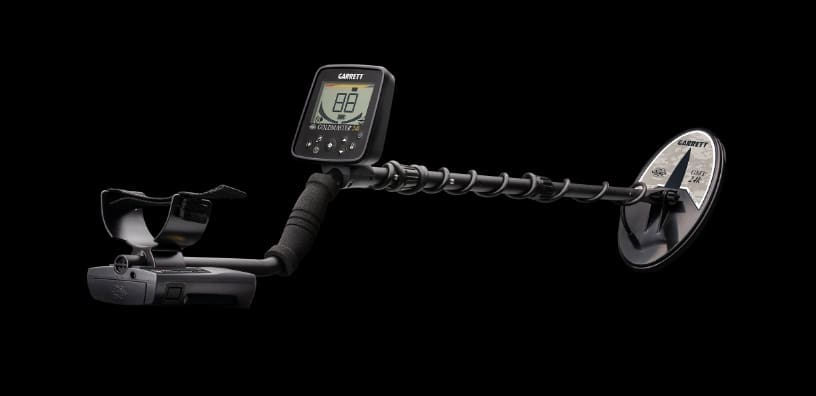
Whether you’re a security professional screening passengers at an airport, a treasure hunter sweeping a beach for gold and coins, or someone who just picked up their first metal detector and wants to understand how it works, the history of this technology is worth knowing. At Garrett, our team has spent decades working with metal detection technology, and we’ve found that people who understand where this equipment came from get far more out of it, whatever their reason for using it.
This article walks through the full timeline of metal detector history, from the electromagnetic experiments of the 1830s to the walk-through scanners in airports and the portable metal detectors used by hobbyists and professionals worldwide today. We’ll cover the key inventors, the moments that pushed the technology forward, and what all of it means for anyone who uses a detector today.
Key Takeaways
- Electromagnetic experiments in the 1830s laid the scientific groundwork for all modern metal detection.
- Gustave Trouvé built the first metal detector prototype in 1874 to locate bullets inside patients.
- Alexander Graham Bell advanced the technology by using an induction balance device during the Garfield assassination attempt in 1881.
- Gerhard Fischer secured the first electronic metal detector patent in 1925, launching the commercial era.
- Charles Garrett revolutionized the industry after founding Garrett Electronics in 1964, turning metal detecting into a mainstream hobby.
- A 1972 U.S. mandate to screen airline passengers made metal detectors essential public infrastructure worldwide.
The Precursors: Early Science Behind Metal Detection (Pre-1874)
The Foundational Role of Electromagnetism
The science that powers every modern metal detector goes back nearly 200 years. Around 1830, early electrical conductivity methods were used to locate metal underground. By 1841, scientists had developed induction-based devices capable of detecting metal objects using electromagnetic principles rooted in magnetic induction. These weren’t practical tools yet, but they established the scientific foundation everything else would be built on.
German physicist Heinrich Dove took things a step further by inventing the induction balance system. In its simplest form, this principle uses a coil producing an alternating magnetic field to sense nearby conductive material, and it would later be incorporated into walk-through metal detectors and handheld devices alike. These early experiments were slow, fragile, and far too complex for everyday use, but without them, none of the breakthroughs that followed would have been possible.
The First Metal Detector: Gustave Trouvé (1874)
Gustave Trouvé was a French electrical engineer known for miniaturizing electrical devices. In 1874, he created what is widely considered the first metal detector, and he built it for a medical purpose: locating bullets lodged inside patients. His device was a genuine prototype of a crude metal detector, small enough to hold and functional enough to scan a person’s body for foreign bodies such as bullet fragments or other metallic objects.
Trouvé’s invention never reached widespread use. It was a one-of-a-kind creation that didn’t translate into a commercial product. Even so, it matters enormously. Trouvé proved that electromagnetic principles could be packaged into a portable, practical device, and that conceptual foundation influenced every metal detector that came after it, from early industrial models to the detector you might own today.
Alexander Graham Bell and President Garfield (1881)
The Historical Context
In July 1881, President James Garfield was shot by an assassin in a Washington, D.C. train station. The bullet lodged deep inside his body, and doctors could not locate it. Alexander Graham Bell, already famous for inventing the telephone, was brought in to help. His mission was to find the bullet before it killed the president, and he approached it as a research engineer solving a life-or-death detection problem.
Bell adapted his electromagnetic telephone research into what he called an “Induction Balance” device. The machine used magnetic induction and alternating current passed through a search coil to scan Garfield’s body for the bullet. It was one of the most dramatic real-world tests any new technology had ever faced, and it captured the public imagination in a way that no laboratory experiment could.
Bell’s “Induction Balance” Device
Bell’s device worked, at least in principle. It successfully detected metal using alternating electromagnetic fields at low frequency, generating eddy currents in conductive material that the device could sense.
However, the assassination attempt ultimately proved unsuccessful because the metal coil spring bed that Garfield was lying on confused the signal. The device picked up the springs instead of the bullet lodged in the president’s body, and Garfield died weeks later from infection.
The Legacy of Bell’s Work
Despite the tragic outcome, Bell’s experiment proved the concept of the induction balance was viable for real-world use. A handheld electromagnetic detector could scan a person’s body quickly and non-invasively to detect foreign bodies.
That proof of concept paved the way for the serious commercial development that would follow in the coming decades, and Alexander Graham Bell remains one of the most important figures in the entire history of the device.
The Modern Metal Detector Is Born: Gerhard Fischer (1925–1931)
Fischer’s Background and the Navigation Problem
Gerhard Fischer was working on a radio direction-finding system, what would today be called airborne direction finding equipment, intended for precise and accurate navigation when he noticed something unexpected: metal ore in the ground was interfering with his radio signals.
Rather than treating this as a problem to work around, Fischer recognized it as a solution to an entirely different challenge, detecting metal objects and enabling metal and mineral detection in ways that hadn’t been possible before. That navigation problem became the insight that launched modern metal detection.
Fischer understood that if metal disrupted electromagnetic signals in a predictable way, that disruption could be measured and used to locate metallic objects beneath the ground. He went on to found Fisher Research Laboratory, where much of his early detector development took place, and his work was featured in publications including Radio News.
The First Patent
In 1925, Fischer was granted the first-of-its-kind patent for an electronic metal detecting device. However, it’s worth noting that the first person to actually apply for a metal detector patent was businessman Shirl Herr of Crawfordsville, Indiana, whose application was filed in February 1924, though it wasn’t patented until July 1928.
Fischer’s first patent and Herr’s application arrived close together, reflecting a moment when multiple inventors were converging on the same idea from different directions.
From Patent to Product
Fischer began selling commercial metal detector units in 1931. These early metal detectors relied on vacuum tubes rather than transistors, which made them large, heavy, and prone to oscillator drift, a common type of instability in early electronic detection circuits.
They required significant expertise to operate and were a far cry from the lightweight, intuitive portable metal detector that most people picture today. Still, the commercial era had begun, and the technology would only improve from there.
From Wartime Tool to Everyday Use: Industrial and Military Applications
1930s – Industrial Use Begins
The first industrial metal detectors found their footing in mineral prospecting, metal and mineral detection, and ore location. Mining operations needed a faster, more reliable way to locate metal deposits underground, and Fischer’s technology delivered. What began as a niche scientific instrument made the shift from novelty to necessity within just a few years. At this stage, the metal detecting hobby had not yet emerged, all early adopters were industry and government, using the first industrial metal detectors to solve practical problems in the field.
This early industrial adoption drove real-world refinement of the technology. Detectors had to become more reliable and more portable to survive in mining and field environments. That pressure to perform in rugged conditions shaped how metal detector design evolved across the following decades, eventually producing equipment practical enough for individual ownership.
World War II – Landmine Detection
De-mining – the detection of landmines and wires buried beneath the ground – became one of the most critical applications of metal detector technology during and after the Second World War. Józef Kosacki’s first portable metal detector was produced in large quantities and deployed across active war zones.
Soldiers were trained to use electromagnetic detection devices as standard battlefield equipment, and the demand for reliable, rugged, portable metal detectors pushed the technology forward significantly during this period.
Post-War Civilian Expansion
After World War II, transistor technology made devices smaller and more efficient, bringing early metal detectors into civilian life for the first time. Battery-powered, portable units emerged in the 1950s and 1960s, putting metal detecting within reach of ordinary people for the first time.
Hobbyists, archaeologists, farmers, and amateur historians all began finding uses for a tool that had previously belonged only to scientists and soldiers. This era also saw the birth of the metal detecting hobby and the formation of early metal detecting clubs where enthusiasts shared techniques for locating gold, coins, relics, and other targets, including low conductivity targets that required more sensitive equipment to detect.
Charles Garrett and the Transformation of Metal Detecting
A Research Engineer with a Mission
No history of the metal detector would be complete without Charles Garrett. He founded Garrett Electronics in 1964, starting in a garage, with a clear goal: to build reliable, precise, and accessible detectors for everyone from treasure hunters to security professionals.
As an engineer, he eliminated the oscillator drift that had plagued early machines through patented coaxial search coil winding techniques, and pioneered microprocessor-based target identification that allowed users to distinguish between metallic objects with far greater accuracy than before.
An avid treasure hunter himself, he also authored numerous books and guides that helped transform metal detecting from a niche pursuit into a mainstream hobby with a global community behind it.
Pioneering Modern Metal Detector Design
In 1984, Garrett developed the Super Scanner – which became the world’s most popular handheld security metal detector, widely adopted for school, airport, and Olympic security screening. His work advancing pulse induction technology, digital signal processing, and search coil design pushed the entire industry forward, improving depth, target discrimination, and performance in challenging environments like mineralized ground.
His company grew from that garage into one of the world’s largest manufacturers of both hobbyist and security detectors – and his products remain widely recognized for uncovering historical artifacts and protecting people at access points around the world.
The Security Revolution: Airport and Access Control Screening
The 1972 Turning Point
A series of aircraft hijackings led the United States in 1972 to adopt metal detector technology to screen airline passengers at airports across the country. Walk-through magnetometers became standard at airport security checkpoints – a transformation that happened quickly because the threat was urgent and the technology was ready.
The same magnetometers originally developed for industrial and logging operations were adapted for passenger security screening, and the concept of using a detector to scan a person’s body for concealed metallic objects became a formal security standard almost overnight.
This was the moment that turned metal detection from a useful specialized tool into essential public infrastructure. Once airports adopted it, the model spread rapidly to courts, prisons, schools, stadiums, and government buildings around the world.
Key Milestones Timeline: At a Glance
Here is the complete progression from early science to the detectors in use across the world today:
- 1830 – Early electrical conductivity experiments used to locate metal underground
- 1841 – Induction-based detection principles developed using magnetic induction and electromagnetic science
- 1874 – Gustave Trouvé builds the first metal detector prototype – a crude metal detector designed to detect foreign bodies in patients
- 1881 – Alexander Graham Bell’s induction balance device used in the Garfield assassination attempt
- 1924 – Shirl Herr of Crawfordsville, Indiana files the first patent application for a metal detector
- 1925 – Gerhard Fischer granted the first electronic metal detector patent; Fisher Research Laboratory established
- 1931 – First commercial metal detectors become available for purchase, built using vacuum tubes
- 1941 – Polish engineer Józef Kosacki develops a portable mine detector; thousands of units used to detect wires buried underground and landmines during World War II
- 1972 – Metal detectors first deployed in airports in the United States, initially using magnetometers originally designed for logging operations
Understanding The History of Modern Metal Detector Technology
From Trouvé’s crude medical prototype in 1874 to Bell’s induction balance in 1881, Fischer’s first patent in 1925, Garrett’s engineering breakthroughs in the 1960s, and the airport security standard established in 1972 – the metal detector’s journey has always been driven by real people solving real problems.Understanding that history gives every user, whether you’re hunting for gold on a weekend or screening passengers at an airport, greater confidence in the equipment and a clearer sense of what it can do. At Garrett, that’s the kind of knowledge we’ve always believed makes the difference between simply using a metal detector and truly mastering it.