
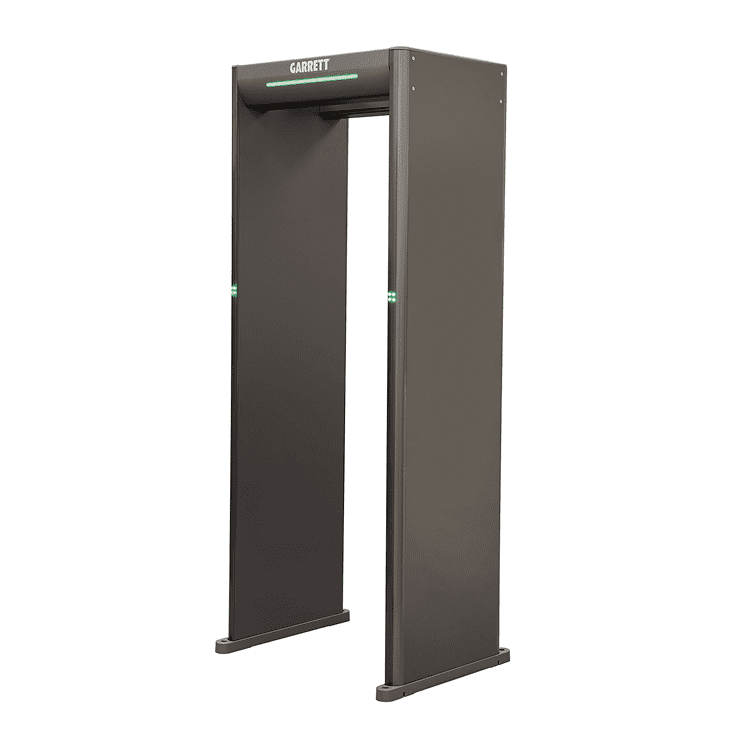
When it comes to weapons detection, the market has never offered more options – or more complexity. Traditional multi-zone metal detectors, AI-powered screening systems, and ultra-portable pop-up units each represent a fundamentally different philosophy about how to balance security, speed, and operational reality.
In this comparison, we’ll put three leading systems head-to-head: the Garrett Paragon, the Evolv Express, and the CEIA OpenGate. The goal isn’t to declare one system universally superior – it’s to help security directors and procurement teams find the right fit for their specific environment.
Quick-Glance Comparison
| Feature | Garrett Paragon | Evolv Express | CEIA OpenGate |
| Detection Technology | 66-zone electromagnetic | Zoneless Electromagnetic | 1-Zone Electromagnetic towers |
| Throughput | Up to 1,800/hr (Single-Lane) | Up to 2,000/hr (dual-lane) | Up to 1,900/hr |
| Weatherproofing | IP65 | IP54 standard / IP56 outdoor | Outdoor-suitable, no formal IP-rating |
| Weight | 152 lbs (single lane) | ~352 lbs (dual lane) | 33.5 lbs per pillar |
| Battery Backup | 1-hr UPS built-in; 8-hr optional | Not available | 7.5 hours typical |
| Setup Time | < 30 seconds | ~5 minutes | < 1 minute |
| Sensitivity Control | 200 levels, 23+ programs | 6 levels, percentage based tuning | 101 levels, ~6 programs |
1. Detection Capability & Accuracy
At the heart of any weapons detection system is a simple question: how well does it find what it’s looking for, and how precisely can it tell you where?
Garrett Paragon
- 66 independent detection zones across left, center, and right columns
- 200 sensitivity levels across 23+ security programs
- Operators can fine-tune detection to venue-specific threats – enabling courthouses and corrections facilities to flag disassembled weapons, USBs, and handcuff keys.
- Full transparency – security staff understand and control how detection decisions are made
Evolv Express
- Zoneless electromagnetic detection distinguishes weapons from benign personal items in real time. Poor nonferrous detection.
- Visual “Red Box” threat location displayed on a 15.6-inch tablet
- Limited operator control over detection logic – the AI functions largely as a black box
- May introduce auditability concerns for organizations with compliance requirements
CEIA OpenGate
- Purpose-built to detect firearms, large knives, and IEDs
- 6 sensitivity levels with percentage based fine-tuning
- Narrower configurability and less granular zone resolution than the Paragon
- Reduced precision due to poor nonferrous detection in threat localization can slow security response
Each system takes a meaningfully different approach to detection. The Evolv prioritizes automation, the OpenGate prioritizes simplicity, but neither matches the Paragon’s combination of granular zone resolution and operator-controlled precision.
Winner: Garrett Paragon. No other system in this comparison gives security operators more precise, transparent, and configurable control over detection. When threat localization and program customization matter, 66 zones and 200 sensitivity levels set the standard.
2. Throughput & Operational Speed
Throughput is often the first number procurement teams look at – and with good reason. A bottleneck at the checkpoint is a security problem, not just an operational inconvenience.
| System | Rated Throughput | Real-World Range | Configuration |
| Evolv Express | Up to 2,000/hr (Dual-Lane) | Free-flowing traffic | Single or dual lane |
| CEIA OpenGate | Up to 1,900/hr (Wide-Lane) | High continuous flow; no stopping required | Adjustable 27″–39″ passage width |
| Garrett Paragon | Up to 1,800/hr (Single-Lane) | Designed for secure, high-throughput venues | Adjacent operation capability – no large exclusion zone |
The Paragon is engineered for high-throughput environments, and actual screening rates will vary based on sensitivity settings, alarm rate, and your facility’s secondary screening protocols. It should be noted that two Garrett Paragons can fit in the space of one Evolv Express.
A number without that context can be misleading. Speed and accuracy are not always in conflict, but when they are, the right choice depends entirely on the stakes of the environment.
Winner: Evolv Express. On raw throughput numbers alone, the Evolv Express leads the field. However, organizations should weigh whether maximizing screening speed at the cost of detection performance and operator control is appropriate for their specific security environment.
3. Ease of Use & Administration
A detection system is only as effective as the people operating it. Ease of administration – from daily setup to real-time adjustments – directly affects how consistently and correctly a system is used in the field.
Garrett Paragon
- NFC-based “Zero Touch” administration allows setting changes without physically touching the unit
- Key-locked panels and crosspieces prevent unauthorized tampering
- Deeper programming options reward trained operators with greater long-term precision
- Physical security layer is built into the hardware itself
Evolv Express
- Tablet-based interface is intuitive and reduces cognitive load during high-volume screening
- Relies on software connectivity and cloud infrastructure
- Organizations with strict IT security policies or limited connectivity should factor in this dependency
CEIA OpenGate
- Configuration requires administrators to download a phone app, and access shouldn’t extend to rotating or minimally trained staff.
- Ideal for temporary deployments where different personnel may set up the system each time but a key supervisor remains constant.
All three systems are designed to be usable without extensive technical expertise, but they serve different operator profiles. The OpenGate suits rotating or minimally trained staff; the Evolv suits officers comfortable with tablet-driven workflows; the Paragon rewards investment in training with unmatched configurability and tamper resistance.
Winner: Garrett Paragon. The NFC Zero Touch system elegantly combines ease of use with enterprise-grade access control, and physical tamper resistance adds a layer of security that software-dependent interfaces cannot replicate. For permanent, high-security installations, that combination is hard to beat.
4. Deployment Flexibility & Portability
Not every security checkpoint is a permanent fixture, and even fixed installations benefit from systems that can adapt to changing venue layouts or operational needs.
| System | Weight | Setup Time | Best Deployment Type |
| CEIA OpenGate | 33.5 lbs per pillar | Under 1 minute; no tools required | Temporary, mobile, rapid-deployment |
| Evolv Express | ~352 lbs (dual lane) | ~5 minutes; built-in wheels | Fixed or limited mobility |
| Garrett Paragon | 152 lbs assembled | < 30 seconds | Highly mobile |
Portability and permanence are opposite ends of a spectrum, and the right position on that spectrum depends on the mission. For organizations building a long-term security infrastructure at a fixed site, the Paragon’s robust construction and environmental resilience make its weight an asset without negating its mobility-capability.
Winner: CEIA OpenGate. For portability and rapid deployment, nothing in this comparison comes close. That said, organizations evaluating security installations should recognize that the Paragon’s weight and form factor reflect its role as the exact right mix of portability and weapons detection capability.
5. Environmental Durability
Weapons detection systems at entry points face real-world conditions – heat, cold, rain, dust, and sustained heavy use. Environmental ratings are not just technical footnotes; they directly affect system reliability and total cost of ownership.
| System | IP Rating | Dust Protection | Water Protection |
| Garrett Paragon | IP65 | Fully dust-tight | Protected against direct water jets from any direction |
| Evolv Express | IP54 standard / IP56 outdoor | Protected against dust | Protected against powerful water jets (outdoor model) |
| CEIA OpenGate | Not formally specified | Outdoor-suitable | Outdoor-suitable |
IP ratings are verifiable, procurement-grade specifications. The absence of a formal rating for the OpenGate isn’t necessarily a red flag for temporary deployments, but for organizations with strict procurement standards or year-round outdoor operations, it is a meaningful gap.
Winner: Garrett Paragon. The IP65 rating is a concrete, verifiable specification that places the Paragon at the top of this group for environmental durability. For any organization operating a fixed outdoor checkpoint, that margin matters.
6. Power & Operational Continuity
A checkpoint that goes dark during a power disruption isn’t a minor inconvenience – it’s a security event. Power resilience deserves more attention than it typically receives in the procurement process.
| System | Built-in UPS | Extended Battery | AC Power Draw |
| Garrett Paragon | 1-hour internal UPS (standard) | Up to 8 hours (optional 14 Ah battery) | 40–60W |
| CEIA OpenGate | N/A – battery-first design | 7.5 hours typical | 100–277V AC (optional) |
| Evolv Express | Not standard | Not available | 200W typical |
Power continuity is one area where the system’s intended deployment context matters enormously. OpenGate’s battery-first architecture represents a fundamentally different, and more robust, philosophy than a grid-dependent system with a UPS backup. Rather than treating battery power as a fallback, CEIA engineered the OpenGate to operate on battery as its primary mode, eliminating the failure point that exists the moment grid power is lost.
With 7.5 hours of typical runtime and broad AC input compatibility (100–277V), the OpenGate is equally at home in a permanent fixed installation or a remote, off-grid deployment. That operational flexibility is difficult to replicate with a system designed around grid dependency.
Winner: CEIA OpenGate. A zero-downtime redundant battery design is slightly more resilient than a grid-first design with battery backup. By making uninterrupted operation the default rather than the exception, OpenGate takes a narrow lead for checkpoint power continuity.
7. Interference Immunity & Operational Spacing
Deploying multiple screening lanes in tight, high-traffic environments, stadiums, airports, arena entrances, demands more than just detection accuracy. Systems that generate cross-talk, require wide buffer zones, or impose complex cabling just to function side-by-side create real operational bottlenecks.
| System | Multi-Unit Interference | Side-by-Side Spacing | Exclusion Zone Requirements |
| Garrett Paragon | Dual-panel field actively cancels cross-talk; no synchronization cabling needed | Portals can be placed directly adjacent; footprint is 35″ W × 23″ D per unit | 20 cm safety separation from antenna; no buffer zone between units |
| Evolv Express | ELF technology with cross-talk filtering; adequate buffer zones required between lanes | Single-lane ~73.8″ wide; dual-lane ~130.6″ wide | 75 cm exclusion zone + 100 cm decision zone per system |
| CEIA OpenGate | Automatic wireless synchronization between lanes; no cabling required | Close parallel arrangements supported; pillar-to-pillar spacing 28–32″ | 36″ clearance from moving metal objects; tablet must be 4–12 ft from pillars |
Where the Evolv Express demands a 75 cm exclusion zone and a separate 100 cm decision zone around each unit, and the OpenGate requires its controller tablet to be positioned 4 to 12 feet away, the Paragon imposes no meaningful buffer between adjacent portals, only a standard 20 cm RF safety margin.
Winner: Garrett Paragon. The Paragon’s dual-panel field architecture actively cancels electronic noise at the source, eliminating the need for buffer zones, synchronization cabling, or wide lane configurations. For any venue running multiple screening lanes in a constrained footprint, no system in this group matches that deployment flexibility.
Best-Fit Use Cases
| System | Ideal For |
| Garrett Paragon | Stadiums, schools, courthouses, airports, transit hubs – permanent, high-security, high-throughput installations requiring precision and durability |
| Evolv Express | High-volume public events where maximizing pedestrian flow is the primary operational objective |
| CEIA OpenGate | Temporary events, mobile security operations, and rapid-deployment scenarios where portability is paramount |
Conclusion
The Evolv Express moves people slightly faster. The CEIA OpenGate deploys faster. But for organizations that need a mobile, high-security checkpoint that needs to perform reliably day after day – in any weather, through any power disruption, with the precision to tell officers exactly where on a person a threat is located – the Garrett Paragon is in a class of its own.
Sixty-six detection zones. Two hundred sensitivity levels. IP65 weatherproofing. A built-in 1-hour UPS. NFC-secured administration. These aren’t just numbers – they’re the specifications of a system engineered for environments where getting it wrong is not an option.
Ready to see the Paragon in action? Whether you’re securing a stadium, school, courthouse, or transit hub, our team will help you find the right configuration for your environment. Contact our team at Garrett today to speak with a security specialist.