
Every time a detectorist swings their coil over a coin or a ring, something invisible is happening underground. Hidden physics is doing all the work behind that satisfying beep, and the star of the show is something called an eddy current. In simple terms, an eddy current is a swirling loop of electric current that forms inside a piece of metal when it is exposed to a changing magnetic field.
Our team at Garrett will break down exactly what eddy currents are, how they work step by step, and why they matter so much to anyone who swings a detector. We will also look at how the same physics shows up in security screening, archaeology, manufacturing, and recycling. By the end, you will understand the science behind every signal your detector gives you.
Key Takeaways
- Eddy currents are swirling loops of electric current induced inside conductive metal when a changing magnetic field passes over it.
- Non-conductive materials like wood, plastic, and stone never produce eddy currents, since only metal reacts this way.
- Eddy current strength varies by target, with silver and copper producing strong, clean signals while small gold nuggets often barely register.
- Detector frequency changes performance, as higher frequencies suit small or low-conductivity targets and lower frequencies favor larger, deeper ones.
- The same eddy current physics also powers security screening, industrial crack detection, and metal recycling sorting systems.
- Garrett builds detectors like the Vortex VX9 and Goldmaster 24k specifically to read eddy current signals as clearly as possible in the field.
Eddy Currents: What They Are And How They Work
An eddy current is a circular flow of electricity created inside a conductive material by a changing magnetic field. The word “eddy” comes from the same idea as an eddy in a river, a small whirlpool that spins in circles instead of flowing in a straight line. Electric current inside metal behaves the same way, spinning in closed loops rather than moving straight through a wire.
- Eddy currents need a conductive material to exist, so plastic, wood, and stone never produce them
- They only form when a magnetic field is changing, not when it stays constant
- Stronger conductors like silver and copper generally produce stronger eddy currents
- The effect was named after the swirling motion of water, not after electricity itself
Eddy currents only form in metals, which is why they show up so strongly in silver, copper, and gold. The phenomenon was first identified by French physicist Léon Foucault in the 1850s, which is why they are sometimes called Foucault currents, a discovery engineers and hobbyists have relied on for over 150 years.
The Simple Analogy
Picture a rock sitting in the middle of a flowing stream. As water rushes past the rock, it does not just flow smoothly around it. Instead, small swirling whirlpools form on the downstream side, spinning in tight little circles before rejoining the main current.
Electrons inside a piece of metal act in a very similar way when a magnetic field sweeps over them. Instead of water swirling around a rock, tiny electric currents swirl around inside the metal itself. This water analogy is exactly where the name eddy current comes from, and it is a helpful mental picture any time the concept feels too technical.
How Eddy Currents Work (Step-by-Step)
Now that you know what an eddy current is, it helps to see exactly how one gets created inside a metal detector. The process happens in four quick stages, all within a fraction of a second.
Step 1: Magnetic Field Generation
It starts inside the detector coil, where a transmitter sends alternating current back and forth many times per second. This constantly reversing current is what makes the entire process work, since a steady, unchanging current would not trigger any reaction in nearby metal.
That alternating current creates an active magnetic field around the coil, and because the current keeps flipping direction, the magnetic field keeps changing too. This constantly shifting field is the essential ingredient needed to produce an eddy current in the first place.
Step 2: The Field Meets Metal
When that oscillating magnetic field sweeps over a piece of conductive metal buried in the ground, something reacts inside the metal almost instantly. The changing field induces circular electric currents to flow within the object itself, even though nothing is physically touching it.
Those induced circular currents are the eddy currents. They exist only for as long as the magnetic field keeps changing, and they form inside the target object rather than inside the detector coil, briefly generating their own electrical activity in response.
Step 3: A Secondary Magnetic Field Is Born
Once the eddy currents start spinning inside the metal target, they do not just sit there quietly. Moving electric current always creates its own magnetic field, so the eddy currents generate a brand new, secondary magnetic field of their own.
This secondary field pushes back against the original field sent out by the coil, either opposing it or distorting its shape. That distortion is small, but it is measurable, and it is the key clue that something metallic is nearby.
Step 4: Detection and Signal
A receiver coil inside the detector is built specifically to notice these tiny distortions in the magnetic field. Once it senses a change, the detector’s circuitry gets to work interpreting what that change means.
The detector converts that distortion into an audible tone or a visual reading on the screen. That beep you hear in your headphones is literally the end result of an eddy current spinning under your coil.
Why Eddy Currents Matter for Metal Detecting
Not every eddy current behaves the same way, and that difference is what makes modern detectors so useful. Strength and behavior change depending on metal type, size, and shape, which gives the detector clues about what it found and forms the basis for target discrimination and ID features.
- A silver quarter typically produces a strong, clean eddy current that reads consistently on the target ID display
- A small gold nugget may barely register due to its size and lower overall mass
- A rusted bottle cap can sometimes fool discrimination settings because it produces a moderate signal despite being trash
- Iron objects interact with the magnetic field differently than non-ferrous metals, which helps detectors flag them separately
Larger or more conductive targets, such as silver or copper coins, produce stronger and more stable eddy currents than smaller items like gold flecks or iron nails. This is why two similar-sized targets can sound completely different in your headphones, and why understanding this variation separates a detectorist who digs everything from one who digs with confidence.
Factors That Affect Eddy Current Strength
| Factor | Effect on Eddy Current |
| Metal type and conductivity | Highly conductive metals like silver and copper produce strong, easy to read eddy currents |
| Object size and shape | Larger surface area generally creates a stronger response than small or thin objects |
| Depth and orientation in the ground | Deeper or awkwardly angled targets weaken the magnetic field interaction |
| Frequency of the detector’s magnetic field | Higher frequencies react more to small or low conductive targets, lower frequencies favor larger targets |
Understanding these factors directly changes how you set up your machine. A detectorist hunting an old homestead might choose a lower frequency for deeper silver targets, while someone hunting a beach for fine gold jewelry might prefer a higher frequency tuned to weaker eddy currents.
Ground conditions add another layer of complexity. Mineralized soil, wet sand, and hot rocks can create weak interference that mimics a real signal, so learning to tell genuine targets from ground noise is one of the most valuable skills a detectorist can develop.
Other Real-World Applications of Eddy Current Technology
Metal detecting is far from the only place this physics gets put to work. The exact same principle behind your hobby also powers several serious industries around the world, many of which most people never think about. The table below highlights a few of the most common real-world uses outside of detecting.
| Industry | How Eddy Currents Are Used |
| Security screening | Detecting concealed weapons or contraband at checkpoints and airports |
| Treasure hunting and archaeology | Locating buried coins, relics, and gold at historical sites |
| Industrial quality control | Non-destructive testing to find microscopic cracks or flaws in manufactured metal parts |
| Sorting and recycling | Separating non-ferrous metals from mixed waste streams automatically |
In manufacturing, eddy current testing is valuable because it finds flaws without cutting into the part. Aircraft parts, pipelines, and railway tracks are regularly checked this way, since a hidden crack could eventually lead to serious failure. Recycling facilities use the same idea at scale, running shredded waste over a spinning magnetic rotor so eddy currents fling non-ferrous metal off the conveyor belt automatically.
Frequently Asked Questions About Eddy Currents
Do eddy currents work on all metals?
Eddy currents only form in conductive materials, so they will not develop in things like wood, plastic, or stone. Among metals, there is also an important split between ferrous metals, which contain iron and react to magnets, and non-ferrous metals, which do not, and each group produces eddy currents a little differently. Common ferrous and non-ferrous metals include the following:
- Ferrous: iron, steel, and nickel
- Non-ferrous: gold, silver, copper, and aluminum
Ferrous metals tend to produce stronger magnetic interference, which can make their eddy current signal behave differently than a non-ferrous metal like gold or aluminum. This is part of why detectors can often tell the difference between a rusty nail and a gold ring.
Why do detectorists need to understand eddy currents?
Understanding eddy currents helps a detectorist make sense of their discrimination settings instead of just guessing at dial positions. Once you know that different metals create different strength signals, adjusting sensitivity and discrimination starts to feel logical instead of random.
This knowledge also helps explain false signals and confusing target ID numbers that do not match what gets dug up. A trash signal and a good target sometimes overlap in their eddy current strength, and knowing why that happens can save a lot of unnecessary digging.
Are eddy currents the same in all detector types (VLF vs. PI)?
Both VLF, which stands for very low frequency, and PI, which stands for pulse induction, detectors rely on eddy currents, but they generate and read them differently. VLF detectors use a continuously alternating current and are generally better at discriminating between target types.
PI detectors send short, powerful pulses instead of a continuous wave, then measure how long the resulting eddy current takes to decay. This makes PI machines especially good at ignoring mineralized ground and finding targets at greater depth, though they typically offer less detailed discrimination than VLF machines.
Detectors We’ve Built Around Eddy Current Technology
At Garrett, we design every detector to read eddy current signals as clearly as possible, since that swirling underground current is the only thing telling you what’s buried. Here’s how two of our machines, one all-purpose and one gold-specific, put that physics to work.
Garrett Vortex VX9
We built the Vortex VX9 with Multi-Dimensional Multi-Frequency technology so it reads eddy current signals across multiple frequencies simultaneously, giving you a fuller picture of what’s underground.
- Multi-Dimensional Multi-Frequency operation across 7 frequency choices, including Multi and Multi-Salt modes
- 3-tier target ID scale paired with 5-tone audible ID and adjustable Iron Audio
- 7 search modes plus user-controlled recovery speed for different terrain and target types
- Fully waterproof to 16 feet, with built-in Z-Lynk wireless audio and a 15-hour rechargeable battery
We designed the VX9 to interpret eddy current strength across several frequencies at once, turning that underground signal into a more confident, better-discriminated read.
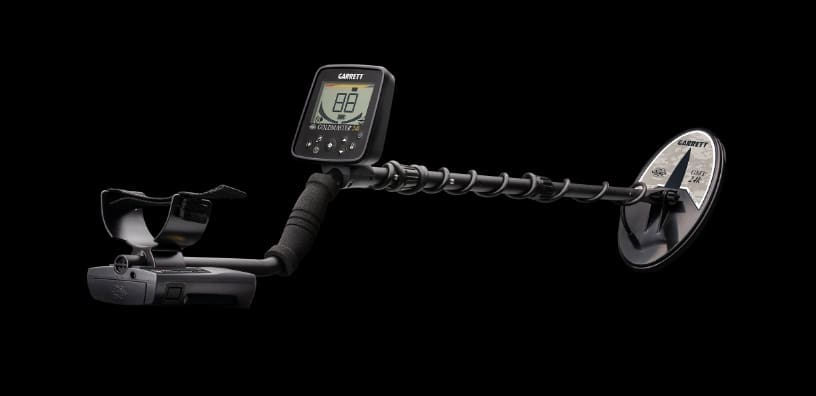
Garrett Goldmaster 24k
We engineered the Goldmaster 24k to run a single high frequency, tuned to pick up the faint eddy currents that small, low-conductivity gold nuggets produce.
- 48 kHz single-frequency VLF operation optimized for small, low-conductivity gold targets
- XGB Auto-Tracking ground balance with Ground-Sync and TracLock to manage mineralized soil
- Two audio modes, 2-tone Beep and VCO Zip, plus adjustable sensitivity from 0 to 10
- Adjustable Iron Cancel to help filter out hot rocks and ferrous trash
Since gold nuggets generate some of the weakest eddy currents of any target, we built the Goldmaster 24k’s high frequency and ground balancing specifically to catch signals a general-purpose detector would miss.
Understanding What an Eddy Current Is And How It Works
Eddy currents are the invisible engine behind every signal a metal detector produces, formed the instant a changing magnetic field meets a conductive object underground. From the swirling water analogy to the four-step process inside your coil, understanding this physics turns your detector from a mysterious black box into a tool you can actually reason about.
That same understanding carries real, practical benefits in the field, helping you set discrimination levels with confidence, make sense of confusing target ID numbers, and dig fewer pieces of trash. Beyond the hobby, this same principle quietly supports security screening, archaeology, manufacturing, and recycling, proving that the physics under your coil is far bigger than any one beep in a field.
Ready to put this knowledge to use in the field? A detector that reads eddy currents clearly makes all the difference between digging trash and digging finds. Check out our selection of sport metal detectors at Garrett and find the machine built to match your next hunt.