
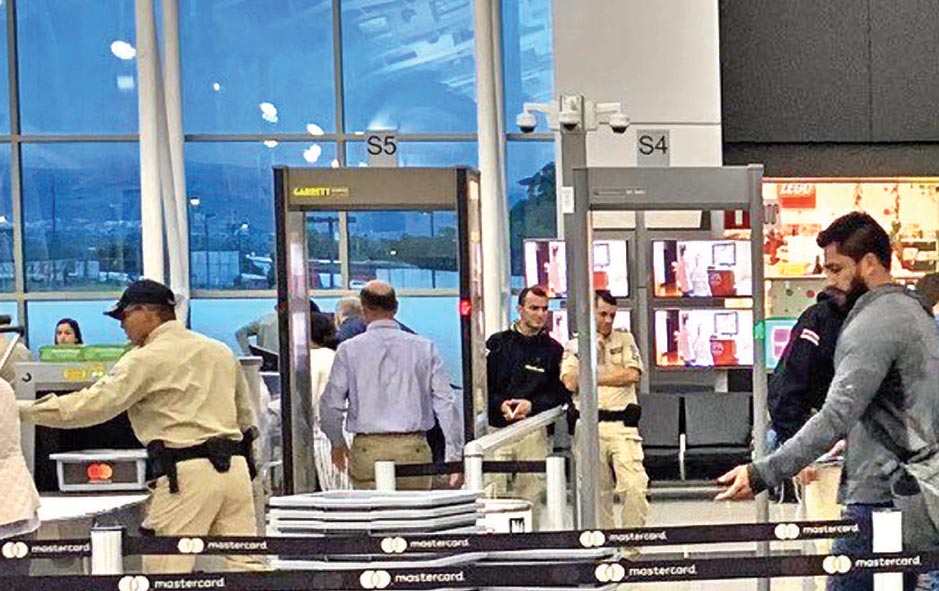
If you are a security professional, understanding how everyday items interact with your equipment is part of doing the job well. Lighters are one of the most common objects your screeners will encounter, and whether they trigger an alarm depends on the type of lighter, the sensitivity setting of your machine, and the screening environment you are operating in.
This article is for security staff who want to understand how lighters behave at different checkpoints, how to configure their equipment appropriately, and how to handle situations where a lighter is discovered during screening. Our team at Garrett is here to help you get the most out of your equipment, from walk-through units to handheld wands, so you can run a screening operation that is consistent, reliable, and built for your specific environment.
Key Takeaways
- Whether a lighter triggers a metal detector depends on the lighter’s metal content and the sensitivity setting of the screening equipment.
- Disposable plastic lighters have minimal metal and often pass through standard venue detectors undetected, while metal-bodied lighters like a Zippo almost always trigger an alarm.
- Airport metal detectors are calibrated to much higher sensitivity levels than most venue or facility checkpoints, making lighter detection far more likely in that environment.
- Security teams should instruct guests to remove pocket items before screening rather than relying solely on the walk-through detector to catch everything.
- A consistent lighter screening operation depends on clear team policies and secondary screening procedures, not just detector alarms alone.
- Garrett’s Super Scanner V handheld wand paired with the PD 6500i walk-through unit provides the most reliable layered approach to catching small metal objects like lighters.
How Metal Detectors Work (and Why It Matters for Lighters)
Metal detectors generate an electromagnetic field that gets disrupted when a conductive object passes through it. The machine does not react to all metal equally, it reacts based on mass, conductivity, and the sensitivity threshold it has been programmed to meet. Small objects with low metal content may pass through without ever triggering a response.
Sensitivity calibration is one of the most important skills a security supervisor can develop. A detector set too low will miss objects it should catch. A detector set too high will alarm on belt buckles and coins, slowing your line and frustrating the people you are screening. Understanding where lighters fall on that spectrum helps you make smarter calibration decisions for your specific post.
What’s Inside a Lighter That Could Trigger a Detector?
The Metal Components in a Standard Lighter
A standard disposable lighter contains more metal than most people expect. The primary component is a steel spark wheel, dense enough to register on a well-calibrated detector. Beyond the spark wheel, lighters also contain a small spring and metal valve components that control fuel flow. Together they represent a real, detectable metal signature, even if a small one.
The plastic housing of a disposable lighter contributes nothing to the metal signature. What your machine is picking up, if it picks up anything at all, is strictly those internal metal components. Whether it does depends entirely on your sensitivity setting.
BIC-Style Lighters vs. Other Types
BIC-style disposable lighters sit at the low end of the detection risk scale. Their metal content is minimal, and at standard screening sensitivity levels, many walk-through units will not alarm on one left in a front pants pocket. This is consistent with what security staff report across venue and transit environments.
Metal-bodied lighters like a Zippo present a very different profile. The entire outer casing, lid, and internal insert are metal, producing a much stronger field disruption. At any well-calibrated checkpoint, a Zippo should reliably trigger your walk-through unit. If it is not triggering at your current setting, that is a signal your sensitivity may be too low for your environment.
Factors That Determine Whether a Lighter Sets Off the Alarm
For security operators, understanding what affects lighter detection helps you configure your equipment and procedures more effectively. These are the factors that most directly determine whether a lighter will trigger your detector:
- The sensitivity and program settings of your walk-through unit at the time of screening
- Whether the lighter is left in a pocket or removed and placed in a tray before screening
- The type and metal content of the lighter, full metal body versus plastic disposable
No single variable tells the whole story. A metal Zippo may sail through a walk-through unit calibrated for a low-security venue, while a plastic BIC might alarm at a data center-grade checkpoint where sensitivity is dialed up. Knowing your equipment settings and matching them to your threat environment is what gives these variables meaning in practice.
Will a Lighter Set Off a Metal Detector at an Airport?
TSA Rules on Lighters
Airport security operates under TSA guidelines that provide useful context for how lighters are treated at the highest-sensitivity environment most screeners encounter. The current rules are:
- Common disposable lighters are permitted in carry-on bags or on a passenger’s person
- Lighters are never permitted in checked baggage under any circumstances
- Torch lighters and non-safety lighters are subject to separate and stricter restrictions
For non-airport security staff, the practical takeaway is that lighters are not inherently prohibited items at most checkpoints. Your job is to apply your venue or facility’s specific policy, not the TSA’s.
Airport Metal Detectors vs. Other Checkpoints
In high-security environments such as data centers, government facilities, and secure research campuses, detection sensitivity is calibrated far beyond what is typical in venues or public facilities. At these elevated settings, even small everyday objects like a disposable lighter can trigger an alarm – and that level of precision is intentional.
Most venue and facility operators run their primary detection equipment at lower sensitivity to balance security with throughput. This means small prohibited items that would alarm in a high-security environment may pass through a standard checkpoint undetected.
For operations requiring very-high security screening, the Garrett Paragon serves as the primary detection platform, delivering the advanced sensitivity and discrimination capabilities these environments demand.
When a secondary screening is required, the Garrett Guide provides dependable, precise follow-up detection – giving security personnel the confidence to locate small metallic objects quickly and accurately without slowing down the flow of personnel through the checkpoint.
Will a Lighter Set Off a Metal Detector at a Concert or Venue?
What Operators and the Public Commonly Report
Walk-through metal detectors are precision instruments, and lighter detection ultimately comes down to how your equipment is configured. A BIC-style lighter contains enough metal to trigger an alarm – whether it does depends entirely on the sensitivity settings and program your operator has selected. This is not a limitation of the technology; it is a reflection of how the equipment has been set up.
If your facility has a no-lighter policy, that policy needs to be enforced through deliberate detector configuration and secondary screening procedures, not through an assumption that your current settings are already catching every lighter that enters. The capability is there – your team simply needs to activate it correctly.
The Real Risk at Venues: Discovery, Not Detection
In most venue environments, lighter discovery happens through pat-downs and secondary screening far more often than through a primary walk-through alarm. A detector set at standard venue sensitivity may not alarm on a small plastic lighter, but a trained screener conducting a thorough secondary check will find it. This is why wanding procedures matter as much as your primary equipment settings.
Venue policies on lighters vary widely, and that variation creates confusion for staff and the public alike. Your screening staff needs a clearly defined policy on lighters before deployment, as they fall into a gray area that a metal detector alone won’t resolve.
Whether lighters are permitted or confiscated upon discovery should be decided in advance and communicated explicitly to your team, so staff aren’t making judgment calls on the floor.
How to Run a Consistent Lighter Screening Operation
A reliable screening operation does not leave lighter detection up to chance. These steps give your team a repeatable process that works regardless of the sensitivity setting on your primary unit:
- Always instruct guests to remove items from their pockets and place them in a tray before walking through
- Use a handheld wand for secondary screening whenever a guest triggers an alarm or raises suspicion
- Brief your team on your facility’s lighter policy before every event so enforcement is consistent across all screeners
- Document prohibited item encounters so you can identify patterns and adjust your procedures over time
Following these steps closes the gap between what your walk-through unit catches and what your policy actually requires. A lighter in a tray is a policy decision your team controls. A lighter in a pocket is a detection problem that depends on your sensitivity settings and the type of lighter.
Industry-Leading Metal Detectors for Modern Security Needs
When it comes to keeping people safe in high-traffic environments, having the right detection equipment makes all the difference. From fixed walk-through systems to portable handheld units, today’s metal detectors offer precision, durability, and intelligent features that help security teams respond faster and screen more effectively.
Garrett PD 6500i Walk-Through Metal Detector
The Garrett PD 6500i sets the standard for walk-through detection, combining precision zone mapping with advanced signal processing to deliver reliable threat identification in demanding security environments.
- 33 Independent Detection Zones: Divided across 11 horizontal and 3 vertical zones, the PD 6500i pinpoints threats from head to toe with surgical accuracy = sensitive enough to flag small metal objects like a lighter = reducing false alarms and helping security staff respond with confidence.
- 20+ Programmable Security Applications: Pre-loaded profiles for airports, courthouses, schools, and more allow security teams to dial in the right sensitivity level for their specific environment without complex manual calibration.
- Advanced Broadband Detection: Simultaneous ferrous and non-ferrous weapon detection ensures the system catches a wide range of concealed threats = from traditional firearms to non-traditional metallic weapons.
- Network-Ready with Remote Management: Compatible with Garrett’s Control Monitor Analyze (CMA) software, the PD 6500i supports remote control, real-time reporting, and traffic counting, making it ideal for large-scale or multi-checkpoint deployments.
For facilities that require high-throughput screening without sacrificing detection accuracy, the Garrett PD 6500i delivers the institutional-grade performance needed to maintain a strong, proactive security posture.
Garrett Super Scanner V Handheld Metal Detector
The Garrett Super Scanner V is the portable complement to any fixed screening setup, giving security personnel a fast, reliable secondary screening tool that works in virtually any environment.
- Wide-Range Threat Detection: Capable of detecting medium-sized pistols from 9 inches, knives from 6 inches, razor blades from 3 inches, and small everyday metal objects like a lighter or foil-wrapped contraband from just inches away, covering a broad spectrum of concealed items.
- Dual Alert Modes for Discreet or Audible Screening: A three-way switch lets operators choose between a sharp audible alarm and a silent vibration alert with red LED indicator, making it adaptable for both public and low-profile screening scenarios.
- 100+ Hours of Battery Life: Running on a single 9V battery, the Super Scanner V is built for extended operations and high-volume screening days without the need for frequent battery changes.
- Weatherproof and Extreme-Temperature Rated: IP54-compliant and operational from -35°F to 158°F, it performs reliably in outdoor checkpoints, event venues, and harsh field conditions where other handheld detectors may fail.
Whether used as a standalone screening tool or paired with a walk-through system like the PD 6500i, the Garrett Super Scanner V ensures that no gap in your security coverage goes unaddressed.
Conclusion: Will a Lighter Set Off a Metal Detector?
For security professionals, whether a lighter sets off a metal detector comes down to two things: the metal content of the lighter and the sensitivity setting of your equipment. A plastic disposable at standard venue sensitivity may pass through without alarming. A metal-bodied Zippo at a high-sensitivity airport-grade checkpoint almost certainly will not.
The most reliable approach is to treat lighter detection as a secondary screening issue rather than a primary detector issue. Instruct guests to remove pocket items, use your handheld wand to follow up on any uncertainty, and enforce your facility’s policy consistently regardless of whether the walk-through unit is alarmed. Knowing your equipment and training your team on secondary screening procedures is what separates a dependable security operation from one that lets prohibited items through by accident.
Ready to strengthen your security setup? The Garrett PD 6500i and Garrett Super Scanner V are built to work together for complete, layered threat detection. Contact us today to find the right configuration for your facility’s needs.