
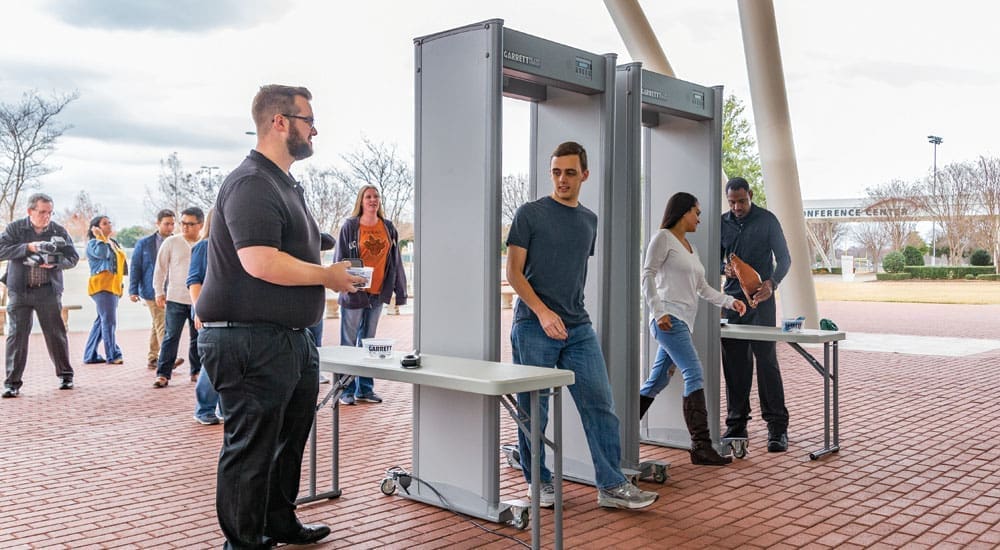
Stadiums, concerts, and festivals are seeing record crowds, and that growth is putting old school security checkpoints under serious strain. Long lines, slow pocket checks, and overwhelmed staff create both safety gaps and frustrated guests. Modern weapons detection systems, like those from Garrett, solve this problem by combining industry-leading sensors, data-driven AI enchancements, and magnetic fields to spot real threats without forcing every attendee to stop and empty their bags.
Our team will break down how these systems work, the main types of technology on the market today, and the real advantages they offer venue operators. You will also find guidance on choosing the right system for your event, best practices for rollout, and common challenges. By the end, you will understand what it takes to build a faster and safer entry experience for any size venue.
Key Takeaways
- Traditional checkpoints can’t keep up. Bag searches create long lines and safety gaps as venue attendance climbs.
- Three core technologies serve different needs. Walk-through gates, multi-zone detectors, and handheld wands each balance speed and accuracy differently.
- By filtering out everyday metal items like phones and keys, modern systems flag real threats instead of harmless objects.
- Faster entry also reduces costs. Venues save on staffing by reassigning workers from manual searches to higher-value security roles.
- The right system depends on venue type. Stadiums favor high-throughput walk-through gates, while government and corporate venues often prioritize the precision of multi-zone detectors.
- Combining tools like Garrett’s Paragon, PD 6500i, and Guide handheld detector across entry and secondary screening catches more threats than any single device alone.
Why Large-Venue Security Has Outgrown Traditional Screening
Attendance at stadiums, festivals, and arenas keeps climbing, and many venues now move more people through the gates in one night than they did during entire seasons just a decade ago. Old checkpoint models built around handheld wands and manual bag searches simply cannot keep pace with that volume. The result is long entry lines, rushed staff, and a higher chance that something gets missed during a quick pat down.
Venue operators and event organizers also face growing legal and financial pressure to prove they took reasonable steps to protect attendees. Insurance carriers and regulators increasingly expect modern screening as part of a venue’s duty of care, and attendees themselves now expect both safety and speed when they walk through the door. These changing expectations are pushing venues of every size toward smarter, faster detection technology.
Types of Weapons Detection Technologies
Venues today have several technology options to choose from, each suited to different budgets, crowd sizes, and security goals. The sections below cover the most common systems in use at large public venues right now.
Walk-Through Systems
Walk-Through, Closed Top Metal Detectors
Closed top walk-through detectors deliver significantly better detection performance and capability than their open top counterparts, and typically cost about half as much. For venues balancing budget with performance, closed top systems are the stronger choice on nearly every metric.
It’s worth noting that most weapons threats are ferrous, but not all. Our walk-through detectors at Garrett are built to detect both ferrous and non-ferrous threats, giving venues broader coverage than ferrous-only detection methods.
Walk-Through, Open Top Metal Detectors
Open top walk-through detectors offer fewer features and lower detection performance and capability than closed top systems, while typically costing significantly more. The one advantage some venues cite is aesthetics, open top designs are considered by some to be more visually appealing at the entrance – but the trade off in detection performance is never ideal.
Traditional Multi-Zone Metal Detectors
Multi-zone metal detectors divide the body into specific height and side zones, which allows them to pinpoint roughly where on a person a metal object is located. This zone based approach gives security staff more precise information than a simple pass or fail alarm.
Because these systems usually require attendees to empty their pockets and sometimes remove belts or jackets, lines move more slowly than with open gate or passive systems. The Garrett PD 6500i is a well known example that fixes the speed issue, and it remains common at venues that prioritize both detection accuracy and rapid throughput.
Handheld Metal Detectors
Handheld metal detectors remain a key tool for secondary screening, especially when a walk-through system flags someone for a closer look. Security staff use these wand style devices to quickly check specific areas of a person’s body, such as a pocket or waistband, without requiring a full pat down. They are lightweight, simple to operate, and do not require any setup beyond charging the battery.
Many venues rely on the Garrett Guide as their handheld device of choice, since it is built specifically for security screening and offers adjustable sensitivity for different environments. While handheld detectors are not meant to replace walk-through systems for high volume entry lanes, they remain an essential backup tool for resolving alarms and handling smaller events where a full detection system may not be necessary.
Quick Comparison Table
| Technology | Throughput Speed | Screening Depth | Best Use Case | Staffing Needs |
| Walk-Through Detectors | Very high | Moderate | High volume stadium and arena entry | Low |
| Multi-Zone Metal Detectors | High | High | High security corporate or government events | High |
| Handheld Metal Detectors | Moderate | Targeted | Secondary screening and resolving alarms | Moderate |
Core Advantages of Modern Weapons Detection Systems
Faster Crowd Flow at Entry Points
Because modern systems filter out everyday items like phones and keys, attendees rarely need to stop and empty their pockets before walking through. This keeps foot traffic moving steadily, even during peak arrival times before a big game or headline performance. Garrett systems in particular combine this high throughput with strong detection capability and performance, so venues don’t have to trade one for the other, and their portability makes it easy to redeploy equipment across different entry points, events, or venues as needed.
Faster entry also means shorter lines outside the venue, which lowers the risk of large crowds gathering in unsecured outdoor areas. Venues that switch from manual checkpoints to industry-leading security screening solutions like those offered from Garrett often see entry times cut dramatically during their first season of use.
Lower Staffing and Labor Costs
Traditional checkpoints require a large number of staff to manually search bags and wand down attendees one at a time. Modern detection systems reduce this need significantly, since the technology handles most of the initial screening on its own.
This change allows venues to reassign staff to higher value roles, such as responding to alarms or monitoring overall crowd safety, rather than performing repetitive manual searches. Over a full season of events, the labor savings can be substantial enough to help offset the initial cost of the equipment. Garrett detectors also support NFC, enabling streamlined data transfer and system connectivity that further reduces the manual work staff need to do.
Fewer False Alarms Through Selective Screening
Older metal detectors tend to alarm on almost any piece of metal, which leads to frequent stops for harmless items like belt buckles or coins. These constant false alarms slow down lines and frustrate both staff and attendees. Because modern systems are trained to recognize actual weapon signatures rather than reacting to all metal, false alarms drop sharply. This means staff spend their time addressing real concerns instead of repeatedly checking pockets for keys and phones.
These systems also catch a broader range of threats than older technology allows: Garrett detectors can identify smaller objects that older systems often miss, including USBs and similar small non-ferrous items, and detect both ferrous and non-ferrous threats overall, an important distinction, since most weapons threats are ferrous, but not all of them are. This gives venues meaningfully broader threat coverage than systems limited to ferrous detection alone.
How to Choose the Right System for Your Venue
The right system depends heavily on venue capacity and the typical size of events held there. A small theater hosting a few hundred guests has very different needs than a stadium that welcomes tens of thousands of fans on game day, so the screening technology should match the expected crowd volume.
Indoor versus outdoor deployment also matters, since some equipment performs better in controlled indoor environments while other systems are built to handle weather exposure at open air venues. Budget plays a role as well, since higher throughput systems often come with a higher upfront cost, and venues need to weigh that against how well the equipment will integrate with existing security tools like cameras and access control systems.
Questions to Ask Before Purchasing
| Question | Why It Matters |
| What is the expected daily throughput | Determines how many lanes and systems are needed to avoid bottlenecks |
| Will the system face weather exposure | Affects whether equipment needs weatherproofing for outdoor use |
| What are the power and connectivity needs | Ensures the venue has the infrastructure to support the system |
| What support and warranty does the vendor offer | Affects long term reliability and repair turnaround time |
| What training does staff need | Determines how much time staff will need before the system runs smoothly |
Matching Technology to Event Type
Stadiums and arenas typically benefit most from walk-through open gate systems, since they need to move large numbers of fans through multiple gates quickly before kickoff or tip off. Concerts and festivals often pair passive magnetic detection with bag check stations, since crowds tend to arrive over a longer window rather than all at once.
Corporate and government venues, on the other hand, often prioritize accuracy over speed, which makes traditional multi-zone metal detectors a better fit. Matching the technology to the specific rhythm and risk level of each event type helps venues get the most value from their investment.
Best Practices for Implementation
Layered Security Design
The strongest security setups rarely rely on a single piece of equipment. Instead, they combine walk-through detectors at the main entry with bag scanners and video analytics working together throughout the venue.
This layered approach means that even if one system misses something, another layer is in place to catch it. Many venues find that combining just two or three of these tools dramatically improves overall coverage compared to relying on one method alone.
Queue Management
Smart placement of stanchions and barriers helps guide attendees into single file lines as they approach a detection system. This matters because most weapons detection technology works best when people pass through one at a time at a steady pace.
Without clear queue management, crowds can bunch up and walk through in clusters, which makes it harder for sensors to read each person accurately. Simple physical layout changes can meaningfully improve both detection accuracy and overall flow speed.
Signage and Attendee Preparedness
Clear signs near the entrance that explain what to expect can reduce hesitation and confusion once attendees reach the checkpoint. When people understand that they can keep their phone and keys in their pocket, they are less likely to slow down or stop unexpectedly.
This kind of preparedness also reduces false stops caused by attendees fumbling with bags or jackets right at the sensor. A few well placed signs can make a noticeable difference in how smoothly an entry line moves.
Alarm Response Protocols
When a system flags a potential threat, staff need a clear and immediate way to respond. Many venues equip security teams with tablets or radios that display real time alerts, including photos from passive detection systems when available.
Beyond just receiving the alert, staff need defined escalation steps to follow, such as who to contact and how to safely separate a flagged individual from the crowd. Clear protocols ensure that alarms are handled consistently no matter which staff member is on duty.
Garrett’s Weapons Detection Lineup for Large Venues
Garrett designs detection equipment that covers nearly every entry point needed, from main gates to secondary screening. Each product is built around the same goal, catching real threats while keeping lines moving.
Garrett Paragon
The Garrett Paragon is a walk-through metal detector built for venues that need fast, modern screening at the main entrance. It pairs precise detection with smart features designed to cut down on false alarms.
- 66 detection zones across 22 horizontal bands for precise left, center, and right identification
- Dual transmit and receive panels that eliminate weak spots and reduce false alarms
- Adjustable settings that can filter out cell phones while still catching weapons
- Built in emergency power and key lock security to keep the system running and protected
These features make the Paragon a strong fit for stadiums and other high traffic venues that need both speed and accuracy. Its flexible setup also allows it to expand alongside a venue’s changing security needs.
Garrett PD 6500i
The Garrett PD 6500i is a multi-zone metal detector built for venues that prioritize precise detection over rapid throughput. It has a proven track record at major events.
- 33 pinpoint detection zones that identify objects from head to toe on the left, center, and right
- Over 20 standard programs for different security applications
- Optional casters and battery module for fast, wireless setup at special events
- Tamper proof settings with multiple access levels for added security
This level of detail makes the PD 6500i a strong choice for airports, courthouses, and other high security settings. Its track record at major global events shows it can handle large crowds without sacrificing accuracy.
Garrett Guide
The Garrett Guide is a handheld metal detector built for secondary screening and resolving alarms from walk-through systems. It replaces the long running Super Scanner as Garrett’s primary handheld unit.
- Seven selectable sensitivity levels for different screening situations
- Lightweight design weighing about one pound for all day use
- Rechargeable battery offering more than 125 hours of runtime
- Waterproof construction built to meet military drop test standards
These features make the Guide a reliable backup tool for staff handling alarms from larger detection systems. Its long battery life and rugged build also make it a good fit for schools, hospitals, and smaller venues.
Garrett IC Module
The Garrett iC Module lets a walk-through metal detector communicate with a laptop or desktop PC over the network, wired or wirelessly, giving staff real-time access to every walk-through detector on the network.
Its group management function lets staff organize and adjust settings across multiple walk-throughs at once, and it can analyze alarm rates, patron counts, and other diagnostics remotely. It works with Garrett Paragon, PD 6500i, and Multi Zone systems.
Building a Safer, Faster Entry Experience With Modern Weapons Detection Systems
Choosing the right weapons detection system comes down to understanding your venue’s size, typical event type, budget, and how well a system will integrate with your existing security setup. The technologies covered in this guide each offer a different balance of speed, accuracy, and staffing needs, so the best choice depends on what matters most for your specific venue.
The right system can make entry faster, safer, and less stressful for everyone walking through your doors. Taking the time now to match your venue’s needs with the right technology can save significant time, cost, and risk once your doors open for the next big event.
Not sure which system fits your venue best? Our team at Garrett has helped venues of every size find the right combination of detection technology to keep entry lines moving without compromising on safety. Reach out to our team at Garrett today for personalized guidance on choosing the right weapons detection system.