
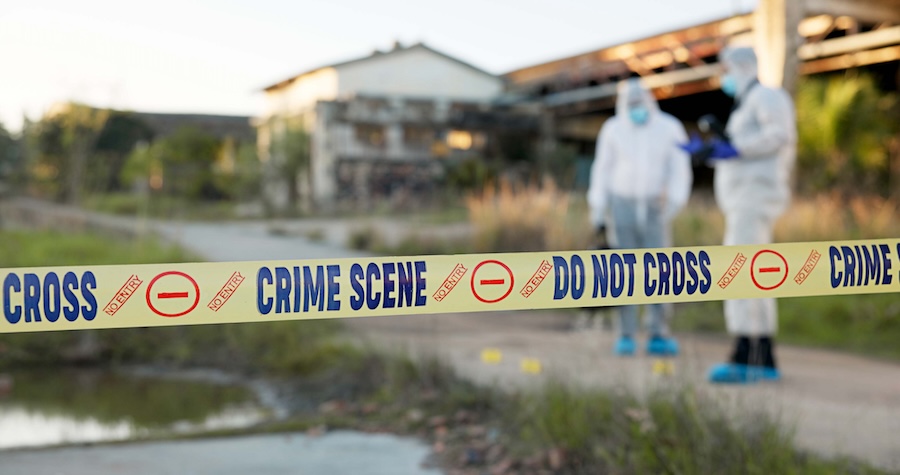
Picture an investigator walking an overgrown lot at dusk. Somewhere in the weeds is a spent casing or a handgun tossed during a foot chase. The ground is full of rusted cans, nails, and broken glass. A basic metal detector beeps at nearly everything, and every false alarm means another hole dug in a scene that should stay as untouched as possible. This is where a standard detector falls short and a forensic-grade detector proves its worth.
So what does “forensic-grade” actually mean? A forensic-grade metal detector is a tool built for evidence recovery, set apart by advanced target discrimination, strict calibration suited to criminal evidence, and extreme durability. At Garrett, we draw on years of working with agencies in the field to explain the five core pillars of a forensic-grade detector. You will also learn how to evaluate models side by side and which questions to ask before you buy.
Key Takeaways
- A forensic grade metal detector is built specifically for evidence recovery, not for hobby treasure hunting.
- Precise conductivity based target ID on a 0 to 99 scale helps investigators identify metals before digging.
- High resolution discrimination filters out urban trash while staying sensitive to small ballistic fragments.
- Bullets Mode and Steel Casings Mode cut false signals at crime scenes.
- Rugged, fully submersible construction lets officers search rivers, ditches, and harsh terrain without equipment failure.
- Garrett’s Vortex CSI line is designed around all five forensic pillars, and agencies should field test any model before buying.
Forensic-Grade vs. Hobbyist Metal Detectors: The Key Differences
At a glance, a hobby detector and a forensic detector can look almost the same. Both have a control box, a shaft, and a search coil. The real differences are inside, in how the unit reads signals, filters out junk, and holds up under hard use. The table below shows how the two compare.
| Feature | Hobbyist Detector | Forensic-Grade Detector |
| Main purpose | Finding coins, jewelry, and relics | Recovering evidence for criminal cases |
| Target ID | Basic categories or a few icons | Precise numeric scale, usually 0 to 99 |
| Discrimination | A handful of settings | As many as 40 distinct levels |
| Search presets | Coin, jewelry, and relic modes | Bullets Mode and Steel Casings Mode |
| Durability | Light plastic, weather-resistant at best | Military-grade, high-impact ABS housing |
| Water use | Splash-proof coil in many models | Fully submersible, often to 10 feet or deeper |
These differences come from two things: the mission and the environment. A tool built for weekend fun is designed around very different goals than a tool built to support a criminal case, and that shows up in every feature listed above.
Different Missions, Different Tools
A hobbyist sweeps beaches and parks looking for coins, rings, and old relics. If a signal turns out to be a pull tab, the only cost is a few minutes and a small hole. Missing a quarter does not change anyone’s life. Hobby detectors are built around this relaxed, low-stakes goal.
Law enforcement has a very different job. Officers are looking for evidence that can make or break a case, such as tiny ballistics like projectiles, fragments, and casings. They also search for buried or discarded weapons and hidden metallic contraband. A single small fragment can link a suspect to a shooting, so the detector must find small targets reliably and tell them apart from trash.
Different Search Environments
Crime scenes rarely happen in clean, open fields. Vacant lots, alleys, and roadsides are packed with heavy urban clutter that can bury a real target in noise. Many regions also have highly mineralized soils, like iron-rich clay or volcanic ground, that confuse less advanced electronics and create constant false signals.
These conditions raise the stakes. On a treasure hunt, a false signal wastes a few minutes. At a crime scene, it wastes valuable time, disturbs the scene, and can damage the chain of evidence. A missed target is even worse, because that evidence may be lost for good once the scene is released.
The 5 Core Pillars of a Forensic-Grade Metal Detector
After years of supporting evidence recovery teams, we have found that forensic-grade performance rests on five pillars. Weakness in any one puts evidence at risk. Use these pillars as your buying standard. Unlike marketing claims, each one can be tested and compared.
1. Conductivity-Based Target Identification
Every metal conducts electricity differently. A forensic-grade detector reads each target’s response and shows it on a precise digital scale, usually 0 to 99. This helps investigators identify metals before digging, including:
- Lead, common in bullet projectiles and fragments
- Brass, used in most handgun and rifle casings
- Copper, found in bullet jackets and some fragments
- Iron, which is often trash but can also be steel evidence
The field benefit is clear. When crime scene investigators know what a target likely is before digging, they make fewer unnecessary excavations and cause less disturbance to the scene. That protects nearby evidence and keeps the search moving.
2. High-Resolution Iron Discrimination
Modern crime scenes are full of trash. Nails, foil, and bottle caps can show up every few feet in an urban lot. A detector that sounds off on all of them forces officers to dig hole after hole, which wastes time and disturbs the area around real evidence.
The answer is fine-tuned target discrimination, with some forensic units offering as many as 40 distinct levels. The goal is balance: rejecting junk signals while staying sensitive to small evidentiary fragments. Our advice is to test how finely discrimination can be adjusted, not just whether the feature exists.
3. Specialized Crime Scene Presets
During an active investigation, nobody wants to spend time adjusting a dozen settings by hand. Purpose-built search modes let officers turn the unit on and start searching with settings already tuned for evidence. Bullets Mode is tuned to find lead projectiles, and it also picks up non-ferrous cartridge casings like brass.
Steel Casings Mode is just as important. Steel-core and steel-cased ammunition reads like iron, so standard settings may reject it as junk. This mode is calibrated to catch those targets instead of filtering them out. Before buying, confirm that the presets match the ammunition types most common in your jurisdiction.
4. Advanced Ground Balancing
False positives often come from the ground itself, not from buried objects. Mineralized soils and saltwater environments both send back signals that can trick a detector into sounding off. Proper ground balancing teaches the detector to ignore the natural signal from the soil so it can focus on actual metal.
Look for two balancing methods. Automatic ground balance adjusts continuously as the terrain changes, which is helpful when moving across mixed ground. Manual ground balance lets experienced operators fine-tune the unit for difficult soil. With both options, geographic interference is neutralized and depth readings become more accurate.
5. Ruggedized and Submersible Engineering
Investigations happen in rough, risky places, from rocky ravines to flooded ditches. A detector that cracks after one drop or shorts out in the rain is a liability. Forensic-grade units are built to military-grade durability standards, often with high-impact ABS housing that holds up to drops, bumps, and harsh weather.
Waterproofing matters just as much. Many forensic models are fully submersible underwater, often to 10 feet or deeper, which allows searches in rivers, swamps, ponds, and heavy rain. Be careful with labels, though. “Weather-resistant” usually means the unit can handle a light shower, not a dive into a creek.
How to Evaluate a Forensic-Grade Detector Before Purchase
Knowing the five pillars is step one. Step two is confirming a model actually delivers, since spec sheets rarely tell the whole story. Combine vendor questions, field testing, and a look at long-term needs. Understanding the different detector technologies also helps you compare units fairly.
Questions to Ask Vendors
A good vendor should answer technical questions clearly and back up claims with data. If a sales rep cannot explain how a feature works, treat that as a warning sign. Bring this list to every vendor conversation:
- What is the target ID scale, and how consistent are readings across depths?
- How many discrimination levels are available?
- Which crime scene presets come standard?
- Does it offer both automatic and manual ground balance?
- What is the rated submersion depth and durability standard?
Pay close attention to the first question. A target that reads 82 at two inches but 60 at six inches can lead officers to skip real evidence. Consistent readings across depth are one of the clearest signs of a well-built forensic unit.
Field Testing Recommendations
The best way to judge a detector is to use it in conditions like your own. Seed a test plot with known evidence types, such as casings, projectiles, and a small weapon, mixed in with common trash like nails and foil. Record where each item is buried and how deep, then see how well each unit finds and identifies them.
Run these tests in your agency’s typical soil and water conditions, not just a clean demo field. Have several officers test each unit, including newer team members. A detector that only works well for your most experienced operator may not hold up under the pressure of a real scene.
Practical Agency Considerations
Think beyond the first day of use. Every detector has a learning curve, so ask about training materials, in-person instruction, and how long it takes a new operator to become confident. Check the warranty length and repair turnaround times as well. A unit stuck in a repair shop for six weeks cannot help during an active case.
The right detector accessories also matter for evidence recovery. Pinpointers help narrow down a target’s exact location, swappable search coils adapt the unit to tight spaces or wide fields, and hard carrying cases protect the gear in transit. Finally, weigh the budget against risk. A cheaper unit may cost far more in the long run if it leads to missed or compromised evidence.
Quick-Reference Checklist: Is It Truly Forensic-Grade?
Use this checklist when comparing models side by side. If a detector cannot check every box, it may be a capable hobby unit, but it is not built for evidence recovery.
| Requirement | What to Look For |
| Target ID | Numeric conductivity-based scale from 0 to 99 |
| Discrimination | High resolution, up to 40 levels |
| Crime scene presets | Bullets Mode and Steel Casings Mode |
| Ground balance | Both automatic and manual |
| Housing | Military-standard rugged construction |
| Waterproofing | Fully submersible to 10 feet or more |
Print this table and bring it to vendor meetings and field tests. It keeps your team focused on measurable features, like how a unit separates steel from other metals, instead of flashy marketing claims.
Garrett’s Forensic-Grade CSI Solutions
At Garrett, we have spent decades building metal detectors trusted by law enforcement and military teams worldwide. Our CSI line was designed around the same five pillars in this guide, giving investigators purpose-built tools for finding, pinpointing, and recovering evidence.
Vortex CSI
The Vortex CSI is our most advanced crime scene metal detector, built to recover metallic evidence across all terrains, including shallow water. We designed it with our Multi-Dimensional Multi-Frequency (MD-MF) technology, which analyzes both the target and the soil around it.
- Bullets Mode recovers lead bullets and brass or copper casings while silencing common iron trash
- Steel Casings Mode identifies steel casings and casings that combine steel with non-ferrous plating
- A two-scale Target ID shows non-ferrous and ferrous readings at the same time
- Fully waterproof to 16 feet, with Beach Mode and Multi-Salt operation for saltwater searches
Each of these features ties directly to the pillars of target ID, discrimination, crime scene presets, ground handling, and submersible design. We built the Vortex CSI so agencies can get true forensic-grade performance in one lightweight, easy-to-learn unit.
PRO-Pointer AT Blackline Edition
We took the world’s best-selling pinpointer and updated it to military standards for CSI and countermine work. The result is a compact, 9-inch tool that detects both ferrous and non-ferrous metals and shows officers exactly where to dig.
- Built to MIL-STD-810 standards and submersible to 20 feet with an IP68 rating
- 360-degree side-scan detection, a pinpointing tip, and a scraping blade for sifting soil
- Fast Retune to tune out mineralized ground and narrow in on a target
- Built-in LED flashlight, molded depth ruler, and a rechargeable battery that lasts up to 30 hours
A precise pinpointer means smaller dig holes and less disturbance to surrounding evidence. We designed the Blackline Edition to match the rugged, forensic-grade standard of the detectors it works alongside.
Vortex CSI Field Kit
For agencies that want to be fully equipped from day one, we created the Vortex CSI Field Kit. It pairs our top crime scene detector with the accessories that speed up evidence recovery, all packed in one zippered case.
- Vortex CSI detector with a 6 x 11 inch DD searchcoil and coil cover
- PRO-Pointer AT Blackline Edition pinpointer for precise target recovery
- CS-3 Z-Lynk wireless headphones with low-delay audio and padded cups that block outside noise
- Test target box, charger, and charging cable for training and quick field checks
The test target box makes it easy to run the field tests and operator training we recommend in this guide. With the kit, your team gets a complete forensic-grade setup instead of piecing one together.
Recap: Investing in the Right Detectors for Evidence Recovery
“Forensic-grade” should never be just a marketing label. It describes a detector that is purpose-built for evidence, with precise target ID, fine discrimination, crime scene presets, smart ground balancing, and rugged, submersible construction. Each of these features exists to help investigators find small, critical items without damaging the scene.
We encourage every agency to judge models against the five pillars and to run hands-on field tests before making a decision. When you are ready, request a demo, compare models side by side, or contact a specialist supplier who understands law enforcement needs. The right detector can be the difference between a case that stalls and one that closes.
Is your agency ready to recover evidence with confidence? Contact our team at Garrett to find the right forensic-grade detector for your crime scene investigations. We’ll help you compare models, arrange a demo, and equip your officers with tools built to protect every case.