
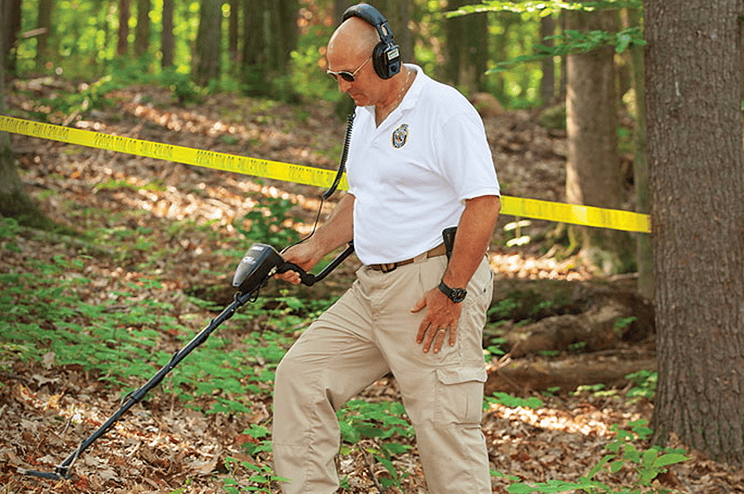
Picture investigators racing the clock at an outdoor crime scene. The light is fading, and every rusted nail, soda can, and bottle cap sets off another false alarm. Each needless dig wastes time, disturbs the scene, and raises the chance that real evidence gets overlooked. That is why forensic teams need a detector that goes beyond the beep.
A purpose-built CSI metal detector pairs proven physics with smart signal processing to help investigators judge which signals are likely evidence and which are likely junk before anyone picks up a shovel. Using our Vortex CSI as the example, our team at Garrett will walk you through the science of telling metals apart, the filters that silence trash, and the ballistics presets that speed up evidence recovery.
Key Takeaways
- CSI metal detectors read phase shift to estimate what kind of metal is buried before anyone digs.
- Ferrous junk like nails and wire reads low on the target ID scale, while most ballistics evidence reads higher.
- Iron discrimination and notch filtering silence common trash without hiding nearby evidence.
- Iron Audio helps investigators spot flat iron items that would otherwise sound like good targets.
- Multi-frequency analysis reduces masking so bullets lying beside debris are less likely to be missed.
- Garrett’s Vortex CSI adds Bullets Mode and Steel Casings Mode to speed up evidence recovery on land and in water.
The Core Science: How a Metal Detector “Sees” Metal
A metal detector does not actually see underground. Instead, it reads how buried objects interact with the detector’s time-varying magnetic field, and every target ID number and tone it gives is based on that interaction. The two most commonly used principles are the induction balance system that transmits and receives signals, and phase-shift analysis that estimates what kind of metal is present.
The Induction Balance System
Nearly every detector used in crime scene work is built on Very Low Frequency VLF induction balance technology. On the Vortex CSI, this happens inside the included 6″ x 11″ DD searchcoil, which both sends and receives signals. The process repeats thousands of times per second as the coil sweeps over the ground:
- The search coil transmits a continuous magnetic field into the ground.
- The field strikes a buried metal object and creates tiny electrical currents, called eddy currents, inside it.
- Those eddy currents cause the target to produce its own opposing magnetic field.
- A receiving coil inside the search head picks up this weaker, returning signal.
The detector then compares what it sent out with what came back. That comparison is what allows the detector to go beyond simply saying metal is present.
Understanding Phase Shift
Think of phase shift as the amount of lag between the transmitted primary magnetic field and the tiny secondary magnetic field generated by the object’s eddy currents. The amount of phase shift, or lag, in a metal object’s secondary magnetic field is a function of the object’s electrical conductivity.
The object’s thickness also influences its effective conductivity since thick objects conduct eddy currents more easily than thin objects. Different types of metals have different conductivities, thereby producing different phase shifts. The detector measures this phase shift and turns it into a target ID number.
This ID number appears on the screen and helps the investigator decide if a signal is worth digging. Without phase shift and ID, a metal detector could only say if metal is present. With ID, the detector and investigator can make an educated guess about what the object is.
Conductivity and the Digital Target ID Scale
Conductivity is how easily electricity flows through a metal. High-conductivity metals and thicker objects create a larger phase shift, while low-conductivity metals and thinner objects create a smaller one. Traditional single-scale detectors use this response to place targets on a 0 to 99 scale, as the table below shows.
| Target ID Range | Metal Type | Phase Shift | Common Items at a Scene |
| 0 to 39 | Ferrous (iron and steel) | Small | Nails, wire, rusted fragments, larger steel tools |
| 40 to 99 | Non-ferrous | Large | Lead bullets, brass casings, copper jackets, gold or silver jewelry |
The Vortex CSI takes this idea a step further. Our multi-axis Target ID display shows two separate scales on the LCD, one for non-ferrous metals and one for ferrous metals. Because the two are split apart, investigators can read a target more clearly instead of trying to sort everything along a single line. Size, thickness, and shape can change where an item lands, so treat these ranges as a guide.
Low Conductivity: Ferrous Metals
Iron and steel produce a very small phase shift, so they land at the low end of the target ID range as ferrous metals. On the Vortex CSI, these responses appear on their own dedicated ferrous scale.
At most outdoor scenes, this range is crowded with nails, fencing wire, and rusted scraps. From what our team has seen alongside search crews, ferrous junk causes many undesired target presentations during a typical evidence sweep.
High Conductivity: Non-Ferrous Metals
Non-ferrous metals generally create a larger phase shift, so they tend to register higher on the scale, where most ballistics evidence lives. On the Vortex CSI, small items like lead bullets and a .22 casing read toward the left of the non-ferrous scale, while larger brass and copper bullets read toward the right.
Complex targets, such as plated casings, can register on both scales at once, giving investigators a helpful clue. Because evidence and junk usually sit in different places, the detector has a natural way to separate them, and the filtering layers below build on that gap.
The Filtering Layers: How CSI Detectors Silence Trash
Phase shift data does not go straight to the investigator’s headphones. First, it passes through several processing layers that sort, mute, or adjust signals based on the settings in use. Each layer handles a different kind of junk problem. The table below gives a quick summary of each filter, how it works, and why it matters at a crime scene.
| Filter | How It Works | Forensic Use |
| High-Resolution Iron Discrimination | Splits the ferrous range into fine segments that can be muted | Quiets nails and wire while still catching larger steel weapons |
| Notch Filtering | Turns off specific target ID numbers | Removes one repeating trash item without hiding nearby evidence |
| Iron Audio | Plays iron as a low tone or at lower volume | Exposes flat iron trash that sounds like a good target |
| Multi-Frequency (MD-MF) Analysis | Compares a target’s response across several frequencies | Reduces masking so evidence near junk is not missed |
High-Resolution Iron Discrimination
This filter divides the ferrous part of the scale into fine slices for precise control. The investigator can then set a cutoff point that mutes only the weakest iron responses instead of all iron at once. The result is a quieter search with less risk. Rust flakes, nails, and fencing wire stop causing alerts, while larger steel objects like knives or tools still trigger a signal.
Notch Filtering and Elimination
Notch filtering turns off certain numbers on the target ID scale while the numbers around them stay active. Think of it like muting one key on a piano while the rest still play. This makes it a precise tool for dealing with one specific type of trash. Our team recommends this simple workflow when one nuisance item keeps showing up:
- Identify a trash item that litters the search site, such as pull tabs at a picnic area.
- Scan one of those items to find its exact target ID number.
- Notch out that number so the detector stops responding to it.
- Resume the sweep and confirm nearby values still sound off normally.
The detector now ignores that repeating nuisance but still responds to evidence that reads just above or below it. This keeps the search moving without giving up coverage of the values where bullets and casings often appear.
Iron Audio™ and Volume Control
Iron Audio brings iron’s low, grumbling tone back into the headphones, even when iron would normally be muted. Investigators can also lower the volume of iron signals while non-ferrous targets stay at full volume.
This matters because flat iron objects, like old tin or bottle caps, can fool a detector into giving a high, “good” tone. With Iron Audio on, a telltale iron grunt mixed into the signal is often enough to recognize trash and skip the dig.
Multi-Frequency (MD-MF) Analysis
A single-frequency detector reads every target through one channel. A multi-frequency system sends out several frequencies at once and compares how a target reacts to each. Because iron and non-ferrous metals respond differently, the detector gets a much clearer picture, and this same Multi-Dimensional Multi-Frequency (MD-MF) analysis powers the Vortex CSI’s two-scale Target ID.
It also fights iron masking, where junk sitting next to a valuable target hides its signal, like a bullet resting beside a rusted fragment. Multi-frequency processing greatly reduces masking, so evidence near debris is far less likely to be missed.
Ballistics-Specific Tuning: Bullet vs. Casing Modes
Factory presets load a ready-made discrimination profile with one button, so teams can start sweeping right away. We designed the Vortex CSI with dedicated modes for ferrous and non-ferrous bullet recovery, plus a lightweight, rechargeable build that is simple to learn.
Bullets Mode
Bullets Mode is built to recover lead bullets and non-ferrous casings, such as brass and copper, while removing common ferrous items from what the investigator hears. It comes preset with iron discrimination that keeps most nails and small rust fragments silent without any manual setup.
This mode works best for fast sweeps across a gridded search area. Investigators can move lane by lane with confidence that the detector is focused on the most common firearm evidence. It is the go-to choice when the type of ammunition is unknown but likely to be standard brass or lead.
Steel Casings Mode
Steel casings read close to iron junk on the scale because of their lower conductivity, so a general iron filter might mute them along with the trash. Some casings add another twist by pairing a steel body with non-ferrous plating, and Steel Casings Mode was designed specifically to identify both types.
It keeps iron debris suppressed while steel evidence still gives a clear, strong signal. Paired with the two-scale Target ID, where plated casings can appear on both scales at once, this mode helps investigators recover steel cases without chasing every nail.
Choosing the Right Mode at the Scene
Picking the right setup comes down to what you expect to find and where you are searching. Our team suggests running through a few quick checks before the first sweep:
- Match the mode to the expected ammunition, using Steel Casings Mode when steel or plated rounds are likely.
- Start with Bullets Mode when the ammunition type is unknown or likely brass or lead.
- Look over site conditions such as urban debris, fence lines, construction remnants, or nearby water.
- Add notch filtering for heavily littered locations, or switch to a smaller coil like our 5″ x 8″ Ripper for tight, iron-heavy spots.
Water does not have to stop the search either. The Vortex CSI is fully waterproof to 16 feet and includes Beach Mode and Multi-Salt operation, so teams can recover evidence from lakes, streams, wet beaches, and saltwater with the same tool they use on dry ground.
Garrett CSI Tools for Faster Evidence Recovery
At Garrett, we build CSI equipment that helps investigators separate evidence from junk metal. Our crime scene line covers every step of a search, from the sweep to pinpointing and recovery, so teams can work faster and protect scene integrity.
Vortex CSI
The Vortex CSI is our most advanced crime scene metal detector, built to recover metallic evidence on land and in shallow water. Every filtering layer covered above comes together in this one lightweight, easy-to-learn unit:
- Multi-axis Target ID with separate ferrous and non-ferrous scales, powered by our Multi-Dimensional Multi-Frequency (MD-MF) technology
- Bullets Mode and Steel Casings Mode for fast, preset ballistics recovery
- Fully waterproof to 16 feet, with Beach Mode and Multi-Salt operation for saltwater searches
- Lightweight build with a USB-C rechargeable battery rated for 15 hours, a display backlight, and an included 6” x 11″ DD searchcoil
Together, these features turn raw signals into better-informed dig or no-dig decisions. That is what moving beyond the beep looks like in the field.
PRO-Pointer AT Blackline Edition
Once you flag a target, the PRO-Pointer AT Blackline Edition helps investigators find its exact location. This military-grade pinpointer, built to MIL-STD-810 standards, updates the world’s best-selling pinpointer for CSI and countermine work:
- 360-degree side-scan detection with a pinpointing tip and proportional audio or vibration alerts
- Fast Retune to tune out surrounding ground or narrow the detection field around larger targets
- Waterproof to 20 feet (6 meters) with an IP68 rating for submerged evidence
- Rechargeable USB-C 9V battery with up to 30 hours of use, plus an LED flashlight and lost pinpointer alarm
A built-in ruler and scraping blade also help investigators judge depth and sift soil without disturbing nearby items. The result is smaller holes, faster recovery, and a better-preserved scene.
Vortex CSI Field Kit
The Vortex CSI Field Kit brings our detector, pinpointer, and wireless audio together in one ready-to-go package. It gives forensic teams everything they need to sweep, confirm, and recover evidence without hunting for extra gear:
- Vortex CSI metal detector with a 6″ x 11″ DD searchcoil and coil cover
- Blackline CSI PRO-Pointer AT pinpointer for precise target location
- CS-3 Z-Lynk wireless headphones with a 17 millisecond audio delay and padded ear cushions that block outside noise
- Test target box, zippered Garrett case, power charger and cable, and Quick Start Guide
The test target box is especially useful for learning how evidence and common trash read before a sweep begins. With the full kit in hand, investigators can separate clues from clutter from the very first pass.
Understanding How CSI Detectors Filter Out Junk Metal
A CSI detector does not just find metal. It interprets what it finds, using physics and signal processing to sort clues from clutter. Phase shift, driven by an object’s conductivity and thickness, forms the scientific foundation of every target ID. Discrimination, notching, Iron Audio, and multi-frequency processing then work in layers to remove junk, while ballistics presets get evidence recovery started faster.
At Garrett, we believe every hole that does not need to be dug is time saved and a scene left undisturbed. When investigators can trust their detector to quiet the trash, they can give their full attention to the signals that matter. Separating clues from clutter protects time, scene integrity, and the evidence that ultimately solves cases.
Ready to stop digging up trash and start recovering more evidence? Contact our team at Garrett today, and we will help you find the right detectors, pinpointers, and accessories to get your CSI team fully equipped for the field.