
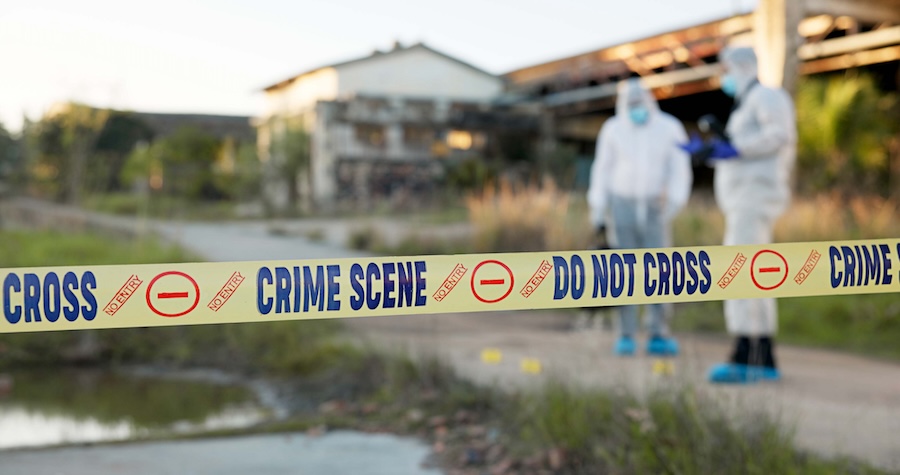
Ask most people what crime scene work looks like, and they will describe an investigator dusting a doorknob for fingerprints or bagging spent shell casings. Those tasks still matter, and they solve plenty of cases. But they only scratch the surface. Many key clues are buried under ash, hidden in soil or sealed away in places the eye simply cannot reach.
Over the years, forensic detection has grown into a set of specialized fields, with tools ranging from ground-penetrating radar to photoionization sensors. Our team at Garrett has worked alongside law enforcement and forensic teams for decades, and we built the Vortex CSI to recover the metallic evidence that other methods miss.
We’ll look at three scenarios where these tools make a real difference: detecting invisible arson accelerants, uncovering hidden graves and locating buried or concealed contraband.
Key Takeaways
- Many crucial clues at crime scenes are hidden under ash, soil or water where traditional methods cannot reach.
- Vapor detectors and alternate light sources help arson investigators locate accelerants and the fire’s point of origin.
- Ground-penetrating radar and resistivity surveys map hidden graves without disturbing the soil.
- Backscatter X-ray reveals concealed organic contraband, while metal detectors confirm weapons and ammunition.
- The metal detector is the only tool used across arson, burial and contraband investigations.
- Garrett’s Vortex CSI offers bullet-focused search modes, waterproof performance and simple controls for any scene.
Sniffing Out Arson: Vapor Detectors and Alternate Light Sources
A fire destroys much of the evidence investigators need. Still, an intentional fire almost always leaves traces behind, hidden under soot and debris. Arson teams use chemical sensors and special lights to find where a fire began. A crime scene metal detector then recovers the objects that tie the fire to a person.
Why Fire Scenes Are So Hard to Read
After a fire, soot and ash cover almost every surface. Walls collapse, furniture melts and water from fire hoses pushes debris around the room. Much of the evidence ends up hidden, broken or scattered far from where it started.
Burn patterns alone rarely prove arson, since airflow, room shape and building materials all change how flames spread. Investigators need hard evidence, like proof that an accelerant was used or a device was planted, before they can call a fire deliberate. That kind of proof has to hold up in court, so the tools used to find it must be reliable.
Vapor Detectors and Crime Lights at a Glance
Photoionization detectors (PIDs) and combustible gas “sniffers” are handheld tools that sample the air for volatile organic compounds. Trace hydrocarbons from gasoline or kerosene often stay trapped in porous materials like floorboards and carpeting, even after the flames are out. The strongest readings help point investigators toward the spot where the fire started.
Alternate light sources shine UV, violet and blue-green light across a scene. Under these narrow wavelengths, some accelerant residues glow against charred surfaces. Bone and teeth fragments also stand apart from ordinary soot, which helps teams recover human remains that might otherwise be swept away with the rubble.
Where the Vortex CSI Fits at a Fire Scene
Once the point of origin is found, the search shifts to objects buried in the ash around it. The Vortex CSI lets a team sweep debris quickly and flag targets without sifting the whole room by hand. Common metallic finds at fire scenes include:
- Timers, wiring and other parts of ignition devices
- Pry bars, screwdrivers and tools used to force entry
- Bullets and casings from a crime the fire was meant to cover up
- Keys, jewelry and other personal items
The detector’s multi-axis Target ID shows ferrous and non-ferrous readings on two separate scales, so investigators can tell a melted nail from a brass casing before they dig. Paired with a pinpointer, this keeps recovery careful and protects the surrounding scene from unnecessary disturbance. Every recovered item can then be photographed, logged and bagged right where it was found.
Mapping Clandestine Burials: Geophysical and Electromagnetic Sensors
Finding a hidden grave is one of the hardest jobs in forensic work. The ground often looks untouched, and there may be no witnesses or records to point the way. Families waiting for answers depend on search teams getting it right.
Search teams rely on sensors that read what lies beneath the surface. Each tool sees the ground in a different way, and together they narrow a large search area down to a small, focused dig. The result is a faster search that protects the evidence from start to finish.
The Challenge of Finding Unmarked Graves
Cold cases are especially tough. After years pass, plants grow back, rain smooths the surface and the soil settles, leaving few visible clues for searchers to follow. A team may have only a rough idea of the area, sometimes covering many acres.
Digging blindly can damage fragile remains and destroy evidence that might identify a victim or a suspect. That is why non-invasive mapping has become the standard first step before any excavation begins. The goal is to know exactly where to dig before a single shovel touches the ground.
Ground-Penetrating Radar and Resistivity at a Glance
Ground-penetrating radar (GPR) sends high-frequency radio waves into the soil and records the reflections that bounce back. Because dug soil never packs down the same way twice, GPR can outline a burial shaft without moving any dirt. Research shows frequencies between 225 and 500 MHz work best for resolving wrapped and unwrapped remains across different time spans.
Electrical resistivity surveys measure how easily an electric current passes through soil. Decomposition changes soil moisture and chemistry, creating low- and high-resistivity anomalies that shift over time. These readings can help investigators estimate how long remains have been in the ground.
Pinpointing Remains With a CSI Metal Detector
Radar shows where the soil was disturbed, but a metal detector finds the objects themselves. Remains are often buried with metal personal items, and each one helps confirm the location and the identity of the person. Items that frequently turn up during burial searches include:
- Belt buckles and zipper pulls
- Watches and rings
- Key rings and coins
- Bullets or casings linked to the cause of death
Mapping these targets lets teams set tight boundaries before excavation begins, which keeps the dig small and controlled. The Vortex CSI is lightweight, runs on a built-in rechargeable battery and is simple to learn, making it a practical first tool for search teams working long days in rough terrain. Its waterproof design also means a sudden rainstorm will not shut down the search.
Intercepting Hidden Contraband: Industrial Imaging and Magnetic Induction
Criminals hide weapons, drugs and cash in walls, vehicles, backyards and bodies of water, and the more creative the spot, the harder it is to find. Imaging and metal detection tools let investigators search deeper without tearing structures apart, saving time and preserving evidence.
Why Standard Searches Fall Short
Suspects often stash items in places built to look completely normal. A gun may be buried in a backyard, tossed into a pond or tucked inside a wall cavity. A stash box might sit under a few inches of gravel in a driveway.
Visual searches routinely miss these spots, even when trained officers lead them. Without detection tools, teams may have to dig up entire yards or tear open walls just to be sure nothing was missed. That approach takes days and can still come up empty.
Backscatter X-Ray at a Glance
Portable backscatter X-ray scanners are common during tactical raids and vehicle searches. They read radiation that bounces back from a surface, so they can look behind drywall, car panels and marine hulls while working from only one side. Officers can scan quickly without taking a vehicle apart.
Density differences reveal organic materials like narcotics and plastic explosives, even when they are hidden behind metal shielding. Backscatter flags organic threats, while a metal detector confirms metallic ones like firearms, knives and ammunition. Used together, the two tools leave suspects very few places to hide anything.
Searching Tough Ground and Water With the Vortex CSI
Many basic detectors struggle in mineralized soil, wet sand and salt water, where the ground itself creates false signals. The Vortex CSI uses Garrett’s multi-frequency technology and adjustable ground balance to stay steady in conditions where other detectors chatter. It gives investigators reach in places such as:
- Lakes, ponds and streams, since the detector is fully waterproof to 16 feet
- Wet beaches and surf zones, using Beach Mode and Multi-Salt operation
- Highly mineralized fields and roadside ditches
- Tight spaces and iron-heavy sites, with the optional 5″ x 8″ searchcoil
Throwing a weapon into water is one of the most common ways suspects try to get rid of evidence. Searching fresh or salt water with the same tool used on land means fewer gaps, fewer handoffs and a cleaner chain of custody. Bullets Mode also helps freshwater divers and shoreline teams focus on ammunition instead of rusty nails and other iron trash.
Building a Layered Detection Toolkit
A vapor detector cannot find a buried watch, and radar cannot tell brass from steel, so effective forensic teams combine methods. The metal detector is the only tool used in all three scenarios, finding ignition devices in ash, personal items at burial sites and weapons in soil and water. That makes it essential to any forensic kit.
Quick Reference: Which Detector Suits Which Job
The table below sums up which tools fit each type of investigation and where a CSI metal detector adds value. Agencies can use it to spot gaps in their current equipment.
| Scenario | Supporting Tools | Role of the CSI Metal Detector |
| Arson | PIDs and alternate light sources | Recovers ignition devices, tools and casings from ash |
| Burials | GPR and resistivity surveys | Locates personal items and sets dig boundaries |
| Contraband | Backscatter X-ray | Finds firearms and metal stash boxes in soil and water |
When comparing forensic equipment, agencies should weigh depth capability, performance in mineralized ground, portability and durability under harsh conditions. Tools that are easy to carry and hold up in rain, mud and heat tend to get used the most, and the tool that gets used is the one that finds evidence.
Garrett Vortex CSI Features at a Glance
The Vortex CSI was designed around the evidence investigators recover most often. Its search modes are tuned specifically for bullets and casings, which are some of the most common and most important items at a crime scene.
| Feature | What It Does | Why It Matters |
| Bullets Mode | Detects lead bullets and brass or copper casings while silencing common iron items | Cuts time spent digging junk |
| Steel Casings Mode | Identifies steel casings and steel casings with non-ferrous plating | Recovers ammo other settings may ignore |
| Multi-Axis Target ID | Shows ferrous and non-ferrous readings on two scales | Helps identify mixed-metal targets before digging |
| Waterproof to 16 Feet | Works in fresh and salt water | Recovers evidence discarded in lakes and surf |
| Rechargeable Battery | Charges through a USB-C port | Keeps teams running without spare batteries |
For teams that want a complete setup, the Vortex CSI Field Kit adds CS-3 wireless headphones, a Blackline CSI Pro-Pointer AT pinpointer, a test target box and a zippered carry case. That puts detection, pinpointing and training targets in one bag, so a team can deploy quickly and practice between calls.
Recap: The Evolving Reach of Forensic Detection
Specialized detectors solve problems that traditional methods cannot. They find accelerant traces in burned buildings, map hidden graves without disturbing the soil and recover weapons from mud, sand and water. Each one extends what investigators can see and prove. When soot, soil or water hides the truth, these tools give teams a path forward and stronger cases in court.
Non-invasive, evidence-preserving techniques are now the modern standard, and metal detection remains at the center of that approach. The Vortex CSI brings bullet-focused search modes, waterproof performance and simple controls to every type of scene your team faces.
Contact our team at Garrett to get your CSI team equipped properly with the Vortex CSI and see how it can strengthen your agency’s forensic toolkit.